
Colorado Mule Deer Hunting: GMUs, Draw Tags, Seasons & Trophy Potential
Colorado is one of America's premier mule deer states — but every tag requires a draw. Here's how to plan your hunt.
TL;DR — Key Takeaways
- All Colorado deer licenses are limited draw — there are no OTC deer tags for any season or method.
- Colorado's mule deer population is estimated at 400,000+, with the best concentrations on the Western Slope and mountain parks.
- Non-resident deer license costs $506.92, plus qualifying small game license ($104.86), habitat stamp ($12.76), and application fee ($11.49) — about $637 total.
- Best GMU regions: Gunnison Basin (54, 55, 551, 67), White River (11, 33, 42), Middle Park (18, 28, 181), and Sangre de Cristo (82, 86).
- Trophy units require 8–15+ preference points for non-residents, but opportunity units can be drawn with 0–3 points.
- Spot-and-stalk glassing is the dominant hunting strategy on Colorado's open Western Slope terrain.
Mule Deer in Colorado — Population, Range & Trophy Quality
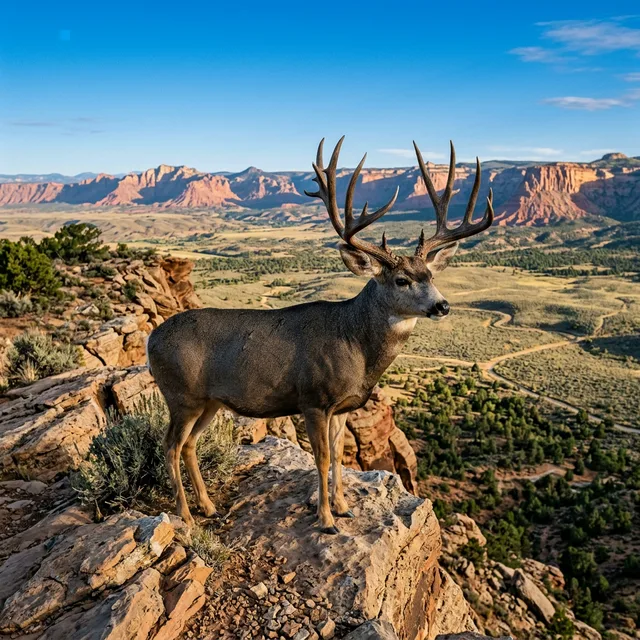
Colorado is home to one of the largest mule deer populations in North America, estimated at 400,000+ animals across the state. Colorado consistently ranks in the top five states for mule deer harvest and trophy quality, with Boone and Crockett-class bucks taken every year from carefully managed units.
Where Mule Deer Live in Colorado
Mule deer occupy a remarkable range of habitats across the state:
| Habitat Zone | Elevation | Terrain | Key Areas |
|---|---|---|---|
| Alpine / Subalpine | 9,000–12,000+ ft | Spruce-fir forests, alpine meadows | High-country summer range |
| Mountain Parks | 7,500–9,000 ft | Sagebrush, grass meadows, aspen | Middle Park, North Park |
| Western Slope | 5,500–8,500 ft | Oakbrush, piñon-juniper, sage | Gunnison, White River, Uncompahgre |
| Eastern Plains | 3,500–5,500 ft | Agricultural, riverine | Arkansas River, South Platte drainage |
During summer (June–August), bucks move to high elevations to feed on lush alpine vegetation while growing antlers. As fall arrives and rifle seasons open, deer migrate downhill through transitional habitats — this migration is the key to successful Colorado mule deer hunting.
Colorado's "Silver State" Reputation
Colorado doesn't produce the enormous 200+ inch mule deer that Iowa County, Utah is famous for, but it consistently produces high numbers of mature 170–185 inch bucks across a very large landscape. The state's strength is the combination of quantity, quality, and public land access — you can find shootable bucks across millions of acres of national forest and BLM land.
Chronic Wasting Disease (CWD)
CWD is present in Colorado's deer herd and is a significant management concern. CPW has established mandatory CWD testing in certain Data Analysis Units and requires carcass transport restrictions in many areas. Before your hunt:
- Check whether your GMU has CWD testing requirements
- Understand carcass transport rules (typically cannot transport the whole head/spine out of CWD surveillance areas)
- CPW offers free CWD testing at designated submission sites during hunting season
Draw vs OTC Deer Tags — Understanding Your Options
Unlike elk (which still has some OTC options), all Colorado deer licenses are limited draw. There are zero OTC deer tags available for any season, method, or unit.
What This Means for Hunters
| Aspect | Details |
|---|---|
| Application required | Must apply during the February–April draw window |
| Preference points | Deer uses the preference point system (queue — most points draw first) |
| Point cost | $40.49/year (NR) to build points without applying |
| Draw odds | Vary dramatically by unit — from 0 points to 15+ points required |
| Second choice | You can list a second-choice unit on your application |
| Leftover tags | Some deer tags appear in leftover sales (mid-July), primarily doe/antlerless |
Tag Categories
| Tag Type | Description | Typical Draw Difficulty |
|---|---|---|
| Buck — Limited | Antlered deer in specific GMU and season | 0–15+ preference points |
| Doe — Limited | Antlerless deer, population management | 0–3 preference points |
| Either-Sex — Limited | Can harvest buck or doe | Moderate |
| Plains Whitetail | Eastern Colorado whitetail-specific units | 0–2 points, some OTC |
Season Dates — Aligned with the 2025–2029 BGSS
Colorado deer seasons mirror the elk season structure under the Big Game Season Structure (BGSS):
| Season | 2025 Dates | Method | Notes |
|---|---|---|---|
| Archery | Sep 2 – Sep 30 | Bow/crossbow | Rut activity beginning for muleys |
| Muzzleloader | Sep 13 – Sep 21 | Muzzleloader only | Overlaps with archery |
| 1st Rifle | Oct 15 – Oct 19 | Rifle | 5 days, limited units |
| 2nd Rifle | Oct 25 – Nov 2 | Rifle | 9 days, most popular |
| 3rd Rifle | Nov 8 – Nov 16 | Rifle | 9 days, peak mule deer rut |
| 4th Rifle | Nov 19 – Nov 23 | Rifle | 5 days, post-rut |
| Plains Rifle | Oct 25 – Nov 4 | Rifle | Eastern plains units |
Best Season for Mule Deer
Third rifle season (November 8–16) is the premier mule deer season in Colorado. Here's why:
- The mule deer rut peaks in mid-November, making bucks more active and visible during daylight hours
- Snow often accumulates by this time, concentrating deer at lower elevations and making them easier to spot against white backgrounds
- Bucks that have been nocturnal all fall become visible during shooting hours as they chase does
- This season is less crowded than the popular 2nd rifle season (which is primarily targeted by elk hunters)
Best GMUs for Mule Deer — Regional Analysis
Gunnison Basin — Best Overall Access
GMUs 54, 55, 551, 67
The Gunnison Basin is Colorado's most accessible mule deer hunting region, offering a vast landscape of sagebrush parks, aspen groves, and spruce-fir forests between 8,000 and 11,000 feet.
- Population: Strong mule deer numbers with consistent buck-to-doe ratios
- Draw difficulty: 1–4 preference points for non-residents (varies by season)
- Terrain: Open sagebrush allows for excellent glassing and spot-and-stalk hunting
- Public land: Over 2 million acres of national forest and BLM — access is rarely an issue
- Best season: 3rd rifle (November) for rutting bucks; 2nd rifle for migration corridors
- Base camps: Gunnison, Crested Butte, Lake City
White River Area — Trophy Territory
GMUs 11, 33, 42, 52, 421
The White River area in northwest Colorado produces some of the state's largest mule deer bucks thanks to favorable genetics, productive habitat, and quality management by CPW.
- Population: Good density with excellent age structure in managed units
- Draw difficulty: 5–10+ preference points for premium buck tags
- Terrain: Mix of oakbrush, piñon-juniper draws, and high-country spruce-fir
- Public land: White River National Forest provides extensive access
- Trophy potential: This region produces 170–190 class bucks regularly
- Base camps: Meeker, Rifle, Craig
Middle Park — Sagebrush Parks
GMUs 18, 28, 181
Middle Park (the broad valley around Kremmling and Hot Sulphur Springs) creates a unique mountain-park ecosystem ideal for mule deer.
- Population: Good numbers in transitional habitat between the Continental Divide and lower elevations
- Draw difficulty: 3–7 preference points for non-residents
- Terrain: Rolling sagebrush parks with aspen-covered hillsides — excellent glassing country
- Migration: Bucks migrate through Middle Park during late October and November, creating predictable hunting opportunities along traditional corridors
- Base camps: Kremmling, Hot Sulphur Springs, Granby
Sangre de Cristo Range — Mountain Giants
GMUs 82, 86, 69, 691
The Sangre de Cristo Mountains in south-central Colorado offer a different mule deer experience — steep, rugged mountain hunting with the potential for very large bucks.
- Population: Moderate density but excellent trophy quality
- Draw difficulty: 2–6 preference points for non-residents
- Terrain: Dramatic vertical relief from 8,000 to 14,000+ feet; hunt the transition zones between piñon-juniper and spruce-fir
- Physical demand: High — steep canyons require excellent fitness
- Base camps: Westcliffe, Salida, Alamosa
Eastern Plains — Accessible Opportunity
Plains units (GMU 87, 95, 133, 140 and others)
Colorado's eastern plains offer an often-overlooked mule deer hunting opportunity with easier draw odds:
- Species mix: Both mule deer and whitetail deer inhabit the plains; some units are whitetail-specific
- Draw difficulty: 0–2 preference points, and some whitetail units offer OTC tags
- Terrain: River bottoms, CRP grasslands, and agricultural fields
- Access: State Wildlife Areas provide walk-in access; additional access through CPWAP programs
- Best for: Hunters wanting a Colorado deer experience without multi-year point building
Non-Resident Mule Deer Costs & Strategy
Cost Breakdown
| Item | Cost | Notes |
|---|---|---|
| Non-Resident Deer License | $506.92 | Includes annual fishing license |
| Qualifying Small Game License | $104.86 | Required before applying |
| Habitat Stamp | $12.76 | Required for ages 18–64 |
| Application Fee | $11.49 | Non-refundable per species |
| TOTAL (Tag Only) | ~$636 |
Strategic Approach for Non-Residents
Year 1–3: Build points while hunting elk. Many non-residents start building deer preference points while using their early years to hunt elk (some OTC rifle elk options remain). Purchase a deer preference point each year for $40.49 while accumulating experience in Colorado.
Year 3–5: Apply for accessible units. Once you have 2–4 points, units in the Gunnison Basin, Sangre de Cristo range, and some Western Slope units become realistic draw options. Target 2nd or 3rd rifle season for the best mule deer hunting.
Year 5+: Target quality units. With 5+ points, White River area and premium Western Slope units open up. Consider a guided hunt for your first trip to these areas to maximize a hard-earned tag.
Spot-and-Stalk Techniques for Colorado Terrain
Glassing — The Foundation
Colorado mule deer hunting is dominated by spot-and-stalk glassing — sitting at high vantage points and using optics to locate deer at distance before planning a stalk.
Essential Optics Setup
| Equipment | Recommended Spec | Purpose |
|---|---|---|
| Binoculars | 10×42 or 12×50 | Primary scanning tool — spend 80% of your time behind binos |
| Spotting scope | 20-60×65 or larger | Evaluating bucks at 500+ yards for antler quality |
| Rangefinder | 1,000+ yard capability | Ranging for shot planning and distance estimation |
| Tripod | Full-size carbon fiber | Essential for steady spotting scope use on windy ridgetops |
Glassing Strategy
- Get high early — Be on a vantage point by first light. Mule deer feed actively during the first 90 minutes of daylight.
- Glass systematically — Divide the landscape into sections and glass each one thoroughly. Don't rush. Patience finds deer that quick scanning misses.
- Focus on the edges — Mule deer favor transitions: where sagebrush meets oakbrush, where aspen meets spruce, where meadow meets timber.
- Watch for movement — A flicking ear, a shadow that shifts — deer often reveal themselves through subtle movement before you spot the animal itself.
- Glass from multiple positions — After 90 minutes, move to a new vantage point. Deer that were hidden behind terrain from your first position may be visible from a different angle.
The Stalk
Once you've located a buck worth pursuing:
- Plan your approach using terrain features (draws, ridges, rock outcrops) for cover
- Check the wind — always approach from downwind. Colorado thermals shift throughout the day: uphill in the morning, downhill in the evening
- Move slowly — take 3–5 steps, then stop and glass. Mule deer have exceptional vision for detecting movement
- Get to within 300 yards if possible before preparing for a shot. The closer, the better.
- Use prone or sitting shooting positions — practice these at the range before your trip
Processing & Transport — Getting Meat Home
Field Processing
A mature mule deer buck yields approximately 50–70 pounds of boneless meat. In Colorado's dry mountain air:
- Quarter the animal immediately after harvest
- Hang quarters in game bags in shade; nighttime temperatures typically provide adequate cooling through October and November
- Bone-out meat if packing long distances to reduce weight by 30–40%
- Record temperatures — meat should stay below 40°F (4°C). If daytime highs exceed 50°F, get meat into a cooler with ice
Transport Rules
- CWD restrictions: In many GMUs, you cannot transport the whole head and spinal column out of the CWD surveillance area. Debone your deer before transporting if in a CWD zone.
- Evidence of sex: Keep external evidence of sex attached to at least one quarter until the animal reaches your permanent residence or a processor.
- State line transport: You may transport legally harvested deer meat across state lines. Carry your tag and license receipt.
Meat Processing Options
- Self-processing at camp: Bring a quality knife set, bone saw, game bags, and a cooler. Many hunters bone-out and bag their deer at camp.
- Local processors: Available in Gunnison, Meeker, Craig, Montrose, Durango, and other mountain towns. Reserve your spot — processors book up during rifle season.
- Ship home: Vacuum-sealed venison ships well via FedEx or UPS Ground. Budget $80–$150 for shipping a deer's worth of meat in insulated boxes.
Recommended Resources
Affiliate links — we may earn a commission at no extra cost to you. Learn more
Frequently Asked Questions
Are there OTC mule deer tags in Colorado?
No. All Colorado deer licenses (mule deer and whitetail) are limited draw. There are no over-the-counter deer tags for any season or method. You must apply during the February–April draw window or attempt to purchase a leftover tag in mid-July.
How many preference points do I need for a Colorado mule deer tag?
It varies dramatically by unit. Trophy-managed units like those in the White River area may require 8–15+ points for non-residents. Accessible units in the Gunnison Basin or Sangre de Cristo range may require 1–4 points. Eastern plains units and doe tags often require 0–2 points.
How much does a non-resident Colorado deer license cost?
The non-resident deer license costs $506.92, which includes an annual fishing license. Adding the required qualifying small game license ($104.86), habitat stamp ($12.76), and application fee ($11.49), the total comes to approximately $636.
When is the best season for mule deer in Colorado?
The 3rd rifle season (November 8–16) is considered the premier mule deer season because it coincides with the peak mule deer rut. Bucks are more active during daylight, and snow often concentrates deer at lower elevations, making them easier to spot.
What is CWD and how does it affect deer hunting in Colorado?
Chronic Wasting Disease (CWD) is a fatal prion disease affecting cervids (deer, elk). CPW has mandatory CWD testing in certain areas and restricts the transport of whole heads and spinal columns from CWD surveillance zones. Check your specific GMU for testing requirements before your hunt. CPW offers free CWD testing at designated sites during hunting season.
Are there whitetail deer in Colorado?
Yes. White-tailed deer inhabit the eastern third of Colorado, primarily along river bottoms and agricultural areas. Some eastern plains units offer OTC whitetail-specific deer tags, and draw odds for whitetail units are generally much easier than prime mule deer units.
Can I do a DIY mule deer hunt on Colorado public land?
Absolutely. Colorado has over 23 million acres of public land including national forests, BLM holdings, and state wildlife areas. The Gunnison Basin alone offers over 2 million acres of public access. Key to success: invest in e-scouting with onX Maps before your trip and plan to glass from high vantage points.
How physically demanding is Colorado mule deer hunting?
It depends on your chosen method and area. Western Slope spot-and-stalk hunting at 8,000–10,000 feet requires good fitness for hiking steep terrain in thin air. Eastern plains hunting is less demanding physically. Start altitude training 12 weeks before your hunt.