
Hunting License vs Permit vs Tag: What Do You Need First in 2026?
A license gives the basic hunting privilege. Permits, tags, stamps, endorsements, and access permits decide what, where, when, and how you can hunt.
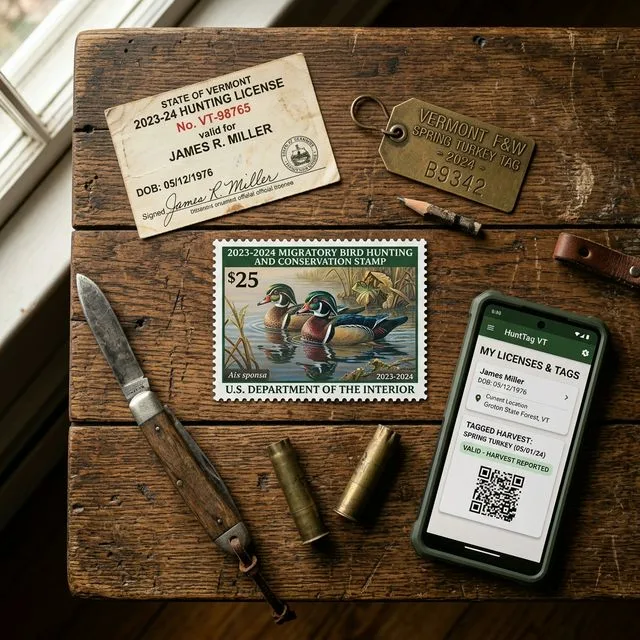
Planning Notes
- Start with the state hunting license, but do not assume it covers every species, tag, stamp, or public-land access rule.
- A permit can mean a species permit, a draw/limited-quota authorization, a WMA or public-land access item, or a special accommodation depending on the state.
- A tag is usually the harvest document for one deer, elk, turkey, bear, or other regulated animal; some states print tags on the license while others sell or award them separately.
- Texas Annual Public Hunting Permit searches are about public-land access, not a replacement for a Texas hunting license.
- Indiana deer permit searches usually need the Annual Hunting license plus either the Deer License Bundle or the correct single-season deer license.
- Wyoming permit and tag searches often belong in the application/draw workflow, so use WGFD Apply for Licenses before assuming a simple buy-now product.
In This Guide 11 sections
Start With The Buying Order
The safest buying order is:
- Confirm the destination state and residency status.
- Buy or qualify for the base hunting license.
- Add the species item: deer, turkey, elk, bear, waterfowl, small game, or other game privilege.
- Add the place item: public-land access permit, WMA permit, refuge permit, drawn hunt permit, or private-land permission.
- Add federal or state stamps when required.
- Carry the required proof in the field and tag or report harvest exactly as the state requires.
The confusing part is that states do not use the same words. A "permit" in one state can behave like a tag. A "tag" can be printed on a license in one state and issued through a draw in another. A "stamp" can be physical, digital, or an endorsement in the license system. Treat the words as state-specific product names, not universal legal categories.
Permit And Tag Planning Map
Users are not only asking for a dictionary definition. They are trying to avoid buying the wrong item.
| Search phrase | What the user likely needs | Safe next action |
|---|---|---|
| "annual public hunting permit texas", "texas aph permit", "public hunting permit texas" | A Texas public-land access answer | Buy the Texas hunting license first, then confirm whether the Annual Public Hunting permit, drawn hunt, or property rule applies |
| "indiana deer hunting permit", "indiana deer permit", "indiana hunting tags" | Indiana deer license choices | Compare Annual Hunting, Deer License Bundle, single-season deer licenses, youth rows, and online fees through Indiana DNR |
| "wyoming hunting permits", "wyoming hunting tag prices" | Wyoming draw, license, tag, and application timing | Use WGFD Apply for Licenses for limited-quota big game and the Wyoming state hub for planning prices |
| "hunting permit", "how much is a hunting permit", "how to get a hunting permit" | A generic "what do I buy?" question | Start with the state license, then layer species, place, stamp, and harvest proof |
| "wma permit", "wma access permit", "limited public use permit" | A property-access rule, not necessarily a species license | Use WMA permit vs hunting license, then check the land manager and state wildlife agency |
| "what are hunting tags", "what is a hunting tag" | Harvest-document meaning | Tags authorize or document harvest and usually must be completed immediately when an animal is taken |
2026 Official-Source Check
These examples were checked on June 13, 2026, against official or agency-controlled sources:
- Texas Parks and Wildlife Department: TPWD public hunting routes APH and drawn-hunt users through the public hunting program, while the Texas hunting license source remains the official license owner. The APH question is an access question layered on top of license, species, tag, and property rules.
- Indiana DNR license fees: Indiana DNR license fees list Annual Hunting, Deer License Bundle, single-season deer licenses, youth deer rows, resident/nonresident deer prices, online fees, hunter education rules, and a footnote explaining that the Deer License Bundle includes privileges for two antlerless deer and one antlered deer but does not satisfy deer reduction zone bag limits.
- Wyoming Game and Fish Department: WGFD Licenses and Applications separates "Apply for Licenses" for limited quota big game, preference points, Super Tag raffle, and other special draws from "Buy Licenses" for fishing licenses, conservation stamps, bird/small game licenses, archery licenses, and similar products. WGFD also says hunters must carry proof of hunter education in the field.
Use these examples as patterns. The final answer always belongs to the destination state's current license system, regulations, and checkout cart.
What A Hunting License Does
A hunting license is the base legal privilege to hunt in a state, unless a narrow exemption applies. It is usually tied to:
- resident or nonresident status
- age, youth, senior, military, veteran, disability, or landowner eligibility
- license year or season year
- hunter education requirements
- the state where the license was issued
A base license does not automatically mean you can hunt every animal, every season, or every property. It often opens the account or legal foundation that lets you add deer, turkey, elk, waterfowl, public-land access, stamps, or draw applications.
License Examples
| Product type | Usually answers | Common mistake |
|---|---|---|
| Annual hunting license | "Can I legally hunt in this state?" | Assuming it includes deer, turkey, elk, or waterfowl everywhere |
| Youth license | "What does a child need?" | Forgetting supervision, hunter education, and tags |
| Nonresident license | "Can I hunt from out of state?" | Forgetting species permits, public-land permits, and high nonresident tag costs |
| Combo or sportsman package | "Can I bundle hunting and fishing?" | Assuming federal stamps or draw tags are automatically included |
| Lifetime license | "Can I buy once for life?" | Assuming it removes annual species permits, Federal Duck Stamp proof, or harvest reporting |
What A Permit Does
A permit is an extra authorization. The exact meaning depends on the state and the property.
Species Permit
A species permit authorizes a particular game category such as deer, turkey, elk, bear, alligator, crane, or antelope. It may be sold over the counter, awarded by lottery, or limited by management unit.
Draw Or Limited-Quota Permit
Western states often use application systems for limited big game. Wyoming is the classic example: a hunter searching "Wyoming hunting permits" may need to apply for a limited-quota license rather than buy a simple counter product.
Public-Land Or WMA Permit
Some "permit" searches are really access questions. Texas APH is the clearest example. The Annual Public Hunting permit helps unlock TPWD public hunting access, but it does not replace the hunting license or species rules. WMA, refuge, military installation, state park, or limited public use permits can work the same way: they answer the "where" layer, not the entire legal stack.
Accommodation Or Special-Use Permit
Some permits allow a special method, mobility accommodation, crossbow use, vehicle access, depredation response, nuisance animal control, falconry, or possession. These should be verified through the agency before relying on them.
What A Tag Does
A tag is the harvest document for a specific animal or animal category. When you harvest an animal, the tag or electronic tag record is the proof that the harvest is legal and counted.
Common tag rules include:
- one tag for one animal or one harvest privilege
- complete the tag before moving the animal
- attach the physical tag or create the required electronic confirmation
- report harvest online, by phone, through an app, or at a check station when required
- keep evidence of sex, species, or head/antlers attached when the state requires it
Do not assume every state sells tags separately. Texas deer tags are commonly printed with the license, while Colorado, Wyoming, Montana, and other states often make big-game tags part of draw or license-specific workflows.
What A Stamp Or Endorsement Does
Stamps and endorsements are add-ons for specific game groups or privileges.
| Add-on | Usually applies to | Practical check |
|---|---|---|
| Federal Duck Stamp proof | Migratory waterfowl hunters age 16+ | Confirm current official checkout, proof, signature, E-Stamp, and vendor-fee rules |
| State waterfowl stamp | Ducks, geese, swans, or state migratory bird programs | Check whether it is a stamp, endorsement, validation, or included privilege |
| HIP registration | Migratory bird harvest information | Usually annual and state-specific; complete it before hunting migratory birds |
| Habitat stamp | Conservation funding or access requirement | Some states require it before hunting or applying for certain licenses |
| Archery or muzzleloader validation | Method-specific seasons | Confirm whether it is included, separate, or tied to draw status |
Real Examples From Current Search Intent
Texas Annual Public Hunting Permit
If the query is "annual public hunting permit texas" or "APH permit Texas," the user is asking about public-land access.
Do this in order:
- Confirm the hunt is on TPWD public hunting land, WMA, state park, leased APH land, national forest, or drawn-hunt property.
- Buy the correct Texas hunting license for resident, nonresident, youth, or exempt status.
- Add APH if the TPWD property or drawn-hunt path requires it.
- Add species rules: deer tags, turkey tags, migratory bird endorsement, HIP, Federal Duck Stamp proof, or other required items.
- Read the map booklet or property page before entering the area.
APH is not a universal hunting license. It is the place/access layer for many Texas public hunting opportunities.
Indiana Deer Permit Or Deer Tags
If the query is "Indiana deer hunting permit," the buyer needs to choose the right Indiana deer product, not merely define the word "permit."
Indiana DNR's license fee page lists:
- Annual Hunting as the base hunting row.
- Deer License Bundle as a deer-specific product.
- Deer Archery, Deer Firearm, Deer Muzzleloader, Deer Reduction Zone, and multi-season antlerless rows.
- Nonresident and youth versions of multiple deer rows.
- A Deer License Bundle footnote: two antlerless deer and one antlered deer privileges, not valid for deer reduction zone bag limits.
- Online purchase fees and hunter education requirements.
The practical answer: buy the base license or qualifying hunting privilege, then choose the deer product that matches the season, deer type, residency, age, and zone. If you are hunting a reduction zone, do not assume the bundle covers that bag limit.
Wyoming Hunting Permits And Tags
Wyoming permit searches often belong to the draw system. WGFD's Licenses and Applications page separates:
- Apply for Licenses: limited quota big game, preference points, Super Tag raffle, and special draws.
- Buy Licenses: fishing, conservation stamps, bird/small game, archery licenses, and other available products.
That distinction matters. If you are hunting deer, elk, antelope, or another limited species, your "permit" may be an application, a limited-quota license, a leftover license, or a tag issued through the WGFD system. Use the official WGFD application path for final dates, quotas, fees, and leftover availability.
One-Page Decision Tree
| Question | If yes | If no |
|---|---|---|
| Do you know the state? | Open that state wildlife agency and license page | Start with the 50-state license directory |
| Do you know the species? | Add species permit/tag/stamp requirements | Do not buy until you know species and season |
| Is the hunt on public land, WMA, refuge, military base, or state park? | Add access permits and property-specific rules | Get written private-land permission and still follow state license rules |
| Is the species migratory waterfowl or migratory bird? | Check HIP, Federal Duck Stamp proof, and state stamp/endorsement | Skip waterfowl add-ons only if the state/species rules truly do not require them |
| Is the product limited quota or draw-based? | Apply during the official window and watch results/leftovers | Buy over the counter only if the agency says it is available |
| Will you harvest big game? | Know tag completion, reporting, evidence, and transport rules before hunting | Still carry license and follow bag limits for small game or birds |
Common Mistakes To Avoid
- Buying only the base license for a deer hunt - many states require a deer permit, tag, bundle, draw license, or reporting step.
- Treating a public-land permit as the hunting license - APH, WMA, refuge, base, and access permits usually answer where you may hunt, not every legal requirement.
- Ignoring residency - nonresident licenses and tags can cost much more and may have different application windows.
- Assuming a combo package includes federal items - state combo or sportsman packages often do not include Federal Duck Stamp proof.
- Confusing hunter education reciprocity with license reciprocity - hunter education proof may be accepted, but hunting licenses themselves do not transfer between states.
- Waiting until opening morning - draw deadlines, paper tags, proof requirements, and online account issues can block a hunt even when the license page looks simple.
Where To Go Next
- Use the hunting license calculator when you need license plus species, stamp, or residency estimates.
- Use the Texas public land and WMA guide for APH, drawn hunts, WMAs, national forests, and public-land access.
- Use the WMA permit vs hunting license guide when the query is WMA license, WMA hunting license, WMA permit, WMA access permit, Management Area Permit, quota, or property-brochure proof.
- Use the Indiana deer license cost guide for bundle vs single deer license decisions.
- Use the Wyoming hunting license page before applying for limited-quota licenses or comparing tag costs.
- Use the Federal Duck Stamp guide for waterfowl-specific proof, signature, and E-Stamp questions.
- How to Get a Hunting License for the First Time: Hunter Ed, Apprentice Path, ID, Tags, and Proof A first-license workflow: choose hunter education or apprentice path, gather ID,…
- Texas Public Land Hunting 2026: APH Permit, WMA, Drawn Hunts & National Forests Plan a Texas public-land hunt with the APH permit, WMA rules, drawn hunts, natio…
- WMA Permit vs Hunting License: Access Permit Is Not the License WMA permit guide: a WMA access, quota or management-area permit usually does not…
Frequently Asked Questions
What is the difference between a hunting license and a hunting permit?
A hunting license is the base privilege to hunt in a state, unless a narrow exemption applies. A hunting permit is an additional authorization that may cover a species, season, draw, public-land area, WMA, refuge, method, or special circumstance. Most hunters should buy the state license first, then add the permit, tag, stamp, or endorsement required for the exact species and place.
Is a Texas Annual Public Hunting Permit the same as a hunting license?
No. The Texas Annual Public Hunting permit is a public-land access layer for many TPWD public hunting opportunities. It does not replace a Texas hunting license, deer tags, migratory bird endorsement, HIP, Federal Duck Stamp proof, drawn-hunt permit, or property-specific rules when those apply.
Do I need an Indiana deer permit or a deer license bundle?
It depends on season, residency, age, and deer type. Indiana DNR lists a Deer License Bundle plus single-season deer products such as archery, firearm, muzzleloader, reduction zone, and antlerless rows. The bundle includes privileges for two antlerless deer and one antlered deer, but Indiana DNR says it cannot be used to satisfy deer reduction zone bag limits.
Are Wyoming hunting permits the same as tags?
Not always. In Wyoming, many big-game questions go through WGFD application, limited-quota, preference point, leftover license, or tag workflows. WGFD separates Apply for Licenses from Buy Licenses, so deer, elk, and antelope hunters should use the official application path before assuming a simple over-the-counter purchase.
Do I need a tag for every animal I harvest?
For many big-game species, yes, but the form varies by state. Some states issue a physical tag, some print tags with the license, and some use electronic tagging or harvest confirmation. Complete the tag or electronic record before moving the animal when the state requires it, and follow any reporting or check-station rules.
Can I buy all my hunting licenses and permits online?
Usually, but not every item is a buy-now product. Many states sell annual licenses, stamps, and some tags online, while limited quota big-game permits, drawn hunts, lifetime licenses, disability permits, refuge permits, or special access permits may require applications, deadlines, paper proof, or agency review. Always confirm the final cart and proof requirements in the official state system.
View Page Update History (2)
- 2026-06-13:Rebuilt the license-vs-permit guide around Texas APH, Indiana deer permit, Wyoming draw/tag, WMA access, and generic permit/tag questions using official-source checks.
- 2026-06-12:Reviewed as a terminology guide; connected license, permit, tag, and stamp questions to calculator and first-time buyer paths.