
First-Time Hunter Checklist: License, Hunter Ed, Apprentice Path, Tags
Use this as the legal order of operations before your first hunt: education or apprentice path, official license, species tags, proof, safe field plan, and reporting.
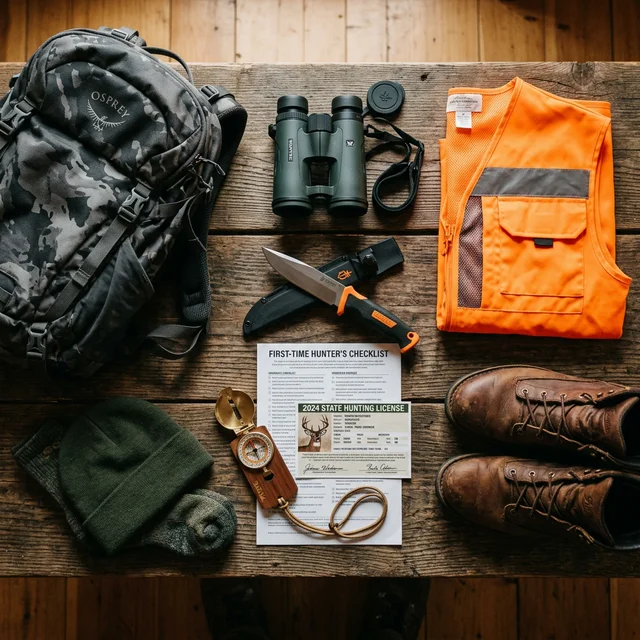
Planning Notes
- Start by deciding whether you will complete hunter education before buying or use a state apprentice or mentored path.
- Buy from the official state wildlife agency portal, not a generic reseller, and confirm the license year before paying.
- A base hunting license is only the first layer; deer, turkey, waterfowl, public-land access, HIP, stamps, and draw permits can be separate items.
- Hunter education certificates that meet IHEA-USA or host-state standards are commonly recognized, but the host state controls accepted proof and course format.
- Indiana apprentice and Ohio apprentice searches need state-specific checkout verification before a new hunter goes afield.
- Carry license proof, ID, hunter education or apprentice proof, tags, land permission, and a hunt plan every trip.
In This Guide 11 sections
- Why a Checklist Matters
- First-Time Hunter Search Map
- Step 1: Choose The Legal Entry Path
- Step 2: Pick The State And Official Portal
- Step 3: Buy The Right License Stack
- Step 4: Carry Proof That Matches The State
- Step 5: Build A Practical Gear Kit
- Step 6: Practice And Make A Hunt Plan
- Step 7: Know The After-Harvest Duties
- Beginner-Friendly Starting Points
- Common First-Time Mistakes To Avoid
Why a Checklist Matters
Heading into the field unprepared can turn a first hunt into a legal or safety problem. A new hunter does not only need "a license." The real stack is education or apprentice eligibility, the official state account, the correct resident or nonresident license, species permits, proof documents, land access, safe equipment, and any harvest reporting step after the hunt.
Official-source warning: Use this checklist to organize the work, but verify your final license, hunter education, apprentice, blaze-orange, season, tag, public-land, and reporting requirements with the official state wildlife agency in the state where you will hunt.
First-Time Hunter Search Map
First-time hunter searches mix education, apprentice paths, state checkout, species tags, field proof, and safety planning. This page should split those decisions before a new hunter goes afield.
The practical search split is:
| Search pattern | What the user really needs | Best next step |
|---|---|---|
| Indiana apprentice hunting license / apprentice hunting license Indiana | Whether Indiana lets a first-time hunter buy an apprentice item before hunter education, and what supervision applies. | Use the Indiana license hub and apprentice license guide. |
| Ohio apprentice hunting license / Ohio youth apprentice hunting license | Whether Ohio's checkout supports the apprentice or youth path for the exact hunt. | Use the Ohio license hub before buying. |
| hunter education certificate reciprocity all states | Whether a certificate from one state works as proof in another. | Use the hunter education reciprocity guide. |
| first time hunting license / how to get a hunting license | The order of education, ID, state account, license, tags, and proof. | Use the first-time license guide. |
| how to get hunting license in Indiana / Ohio / Colorado | State-specific license and tag buying. | Open the state hub and official portal before checkout. |
Step 1: Choose The Legal Entry Path
Before buying anything, decide which path applies.
Path A: Hunter Education First
Most first-time hunters should plan to complete a state-approved hunter education course before buying a regular hunting license. The exact requirement depends on state, age, birth date, license type, and whether an exemption or apprentice path applies.
Keep this proof ready:
- Certificate number
- Issuing state or province
- Original card, digital card, or replacement record
- Course type, especially if it was online-only, online plus field day, bowhunter, or trapper education
Certificates from courses that meet IHEA-USA or host-state standards are commonly recognized across state and provincial systems, but do not treat that as a blank check. The host state still controls accepted proof, portal verification, replacement-card handling, online-course rules, and whether you also need a field day, bowhunter card, trapper card, or species-specific course.
Path B: Apprentice Or Mentored Hunt
If you are not ready to complete hunter education first, check whether the state offers an apprentice or mentored option. This is not a shortcut to hunt alone. It is usually a supervised path that lets a new hunter try hunting while staying close to a qualified licensed mentor.
For apprentice planning, the most important state splits are:
| State query | Safer answer |
|---|---|
| Indiana apprentice hunting license | Indiana DNR lists apprentice licenses for residents and nonresidents. Indiana's public license-fee page says an individual can buy no more than three apprentice hunting licenses in a lifetime, and the apprentice must stay close enough to communicate with a properly licensed adult. Confirm the exact license item, age, residency, species permit, and mentor setup in Indiana DNR or GoOutdoorsIN before hunting. |
| Ohio apprentice hunting license | Ohio apprentice and youth searches should be handled through the Ohio license hub and the Ohio Wildlife Licensing System because license validity, youth items, species permits, and Game Check can affect the final answer. Confirm the current apprentice item and supervision rules with ODNR before relying on it. |
| Other states | Do not copy another state's apprentice rule. The mentor age, distance, lifetime limit, species limits, and youth rules can all differ. |
Step 2: Pick The State And Official Portal
The official state wildlife agency is the final source for license year, price, residency, apprentice status, hunter education proof, tags, draw applications, and harvest reporting. Start with the state hub, then open the agency portal:
- Indiana hunting license for Indiana DNR, GoOutdoorsIN, apprentice, youth, deer, turkey, waterfowl, and lifetime-discontinued context
- Ohio hunting license for ODNR, Ohio Wildlife Licensing System, apprentice/youth, deer permits, Game Check, and annual license timing
- Colorado hunting license for CPW account, qualifying license, draw, OTC, and species tag decisions
- All state license hubs if you are not hunting in one of those states
Before paying, check:
- License year and expiration date
- Resident or nonresident status
- Hunter education, apprentice, age, or exemption proof
- Species license, tag, stamp, HIP, draw, or access item
- Whether digital proof is enough in the field or a paper backup is expected
- Refund, correction, and duplicate-account rules
Step 3: Buy The Right License Stack
A base hunting license is the starting layer. It may not cover the animal, place, or method you want.
| Hunt type | Common extra checks |
|---|---|
| Small game | Base license, hunter education or apprentice proof, season dates, public-land access, blaze-orange rules where applicable |
| Deer | Base license plus deer tag, permit, bundle, draw, county/unit rule, weapon season, CWD and harvest reporting |
| Turkey | Base license plus turkey permit or tag, spring/fall season, unit/zone, reporting |
| Waterfowl | Base license, HIP registration, state waterfowl or habitat item, Federal Duck Stamp proof when required, refuge or WMA rules |
| Public land | State license plus WMA, APH, access permit, refuge permit, check-in, map boundary, or land-manager rule |
If price is unclear, use the hunting license calculator to estimate the stack before checkout. Then treat the official cart as the source of truth.
Step 4: Carry Proof That Matches The State
Carry the proof the state requires, not only what is convenient:
- Government-issued ID
- License or digital license
- Hunter education certificate, apprentice license, or mentor documentation
- Species tag, stamp, permit, HIP number, draw permit, or access permit
- Written private-land permission when hunting private property
- Public-land map, WMA check-in, refuge permit, or access confirmation where required
- Emergency contact and hunt plan
If you are hunting outside your home state, read the reciprocity guide before assuming your certificate will pass the portal check.
Step 5: Build A Practical Gear Kit
Start with safety, weather, navigation, proof, and ethical shot placement. Buy only what the hunt requires.
Required Or Regulation-Driven Items
- Blaze orange or fluorescent pink if the state, season, or property requires it
- Legal firearm, bow, crossbow, ammunition, broadhead, or other method for the species and season
- License, tags, stamps, and proof documents
- Hunter education, apprentice, or mentor proof
Field Safety Items
- First aid kit, personal medicine, and blister care
- Headlamp or flashlight with spare power
- Map, compass, GPS, or offline map
- Weather-appropriate layers and broken-in boots
- Water, snacks, knife, game bags, and a cooler plan
- Whistle or emergency signaling device
What To Delay
Do not let advanced gear distract from the legal checklist. Expensive optics, scent systems, specialized clothing, and premium packs can wait until you know the species, season, property, and method you will actually use.
Step 6: Practice And Make A Hunt Plan
Before the first hunt:
- Practice with the exact firearm, bow, or shotgun setup you will use.
- Know your ethical range and do not stretch it in the field.
- Read the current regulation digest for the species, county, unit, season, shooting hours, legal method, and bag limit.
- Scout the access point, boundary, parking, and exit route before opening day.
- Give a non-hunting contact your location, vehicle location, expected return time, and emergency plan.
Step 7: Know The After-Harvest Duties
A first hunt does not end at the shot. Check before you go:
- Tagging or validation deadline
- Harvest report, Game Check, Telecheck, or online report requirement
- CWD sampling or carcass transport limits
- Waterfowl HIP or band reporting context
- Cooler, processor, field dressing, and meat-care plan
For crossing state lines with meat, antlers, capes, or birds, use the transporting game guide before travel.
Beginner-Friendly Starting Points
Good first hunts are usually simple, supervised, and close to home:
- Apprentice or mentored hunt: Best when a qualified mentor can handle regulation checks and field safety with you.
- Small game: Often lower pressure and useful for learning safe gun handling, woodsmanship, and field awareness.
- Managed or youth hunt: Good when the state agency or property controls hunter numbers and provides clearer instructions.
- Local public land with simple access rules: Good only after you confirm the license, property, species, parking, and check-in requirements.
Common First-Time Mistakes To Avoid
- Buying gear before confirming the license stack.
- Assuming a hunter education certificate automatically clears every state portal.
- Treating apprentice status as permission to hunt alone.
- Buying only a base license when the species requires a tag, permit, stamp, HIP, or draw item.
- Trusting a map layer without checking property rules, season dates, and posted signs.
- Carrying digital proof when the state or property expects paper backup.
- Forgetting harvest reporting, CWD, or transport rules after a successful hunt.
- How to Get a Hunting License for the First Time: Hunter Ed, Apprentice Path, ID, Tags, and Proof A first-license workflow: choose hunter education or apprentice path, gather ID,…
- Apprentice Hunting License: Hunt With A Mentor Before Hunter Education Use this apprentice and mentored hunting checklist to see when hunter education …
- Does a Hunting License Work in Another State? Reciprocity Guide 2026 Your hunting license does not transfer to another state, but hunter education ce…
Frequently Asked Questions
What should a first-time hunter do first?
First decide whether you will complete hunter education before buying a regular license or use an apprentice or mentored pathway. Then pick the state where you will hunt, open the official state wildlife agency portal, and confirm the license year, residency, education proof, species tags, and any public-land or reporting steps before paying.
Can I hunt before completing hunter education?
Possibly, but only if the state offers an apprentice or mentored path and you follow that state's supervision rules. Indiana, for example, lists apprentice licenses and limits an individual to no more than three apprentice hunting licenses in a lifetime. Ohio apprentice searches should be verified in the ODNR licensing system and current regulations before hunting. Never assume another state's apprentice rule applies.
Does my hunter education certificate work in another state?
Often yes when the certificate comes from a course that meets IHEA-USA or host-state standards, but the host state controls the final answer. Confirm the issuing state, certificate number, course format, replacement-card process, and whether online-only, field-day, bowhunter, or trapper education rules apply. The certificate does not replace the host-state hunting license, tags, stamps, or reporting requirements.
Do I need more than a base hunting license?
Usually yes for deer, turkey, waterfowl, elk, bear, public-land access, limited-entry hunts, or special weapon seasons. A base license may only authorize general hunting. Add the species tag, permit, stamp, HIP registration, WMA/access item, draw application, or harvest report required for the exact state and hunt.
What gear should I buy first?
Buy the items the law and safety plan require first: legal method of take, required blaze orange or fluorescent pink, license and tag proof, ID, hunter education or apprentice proof, first aid, navigation, light, weather-appropriate clothing, water, and a meat-care plan. Delay premium gear until the state, species, season, property, and method are settled.
View Page Update History (2)
- 2026-06-13:Rebuilt as a first-time, apprentice, and hunter-education checklist; added Indiana/Ohio apprentice routing, certificate reciprocity cautions, official-portal checks, and removed high-drift gear and cost claims.
- 2026-06-12:Reviewed as a beginner checklist; linked first-license steps to hunter education and cost calculator paths.