All Guides

Hunter Education Course Guide — Online & In-Person Options for 2026

Everything you need to know about hunter education — course options, costs, and state-by-state requirements.

Kevin Luo 9 min read Updated 2026-04-01
Hunter Education Course Guide — Online & In-Person Options for 2026

TL;DR — Key Takeaways

  • Hunter education is required for first-time license buyers in nearly all 50 states.
  • Online courses cost $15-$35 and take 6-8 hours of self-paced study.
  • Once certified, your hunter education card is valid for life.
  • Most states accept other states' certificates through reciprocity agreements.
  • Some states (PA, MI) offer free hunter education courses — check before paying.
In This Guide 12 sections
  1. What Is Hunter Education?
  2. Who Needs Hunter Education?
  3. Course Formats
  4. State-by-State Cost Comparison
  5. Taking the Course: What to Expect
  6. After You Pass: Your Certificate
  7. Hunter Education for Youth
  8. Frequently Debated Questions
  9. Bowhunter Education — A Separate Requirement
  10. Specialty Hunter Education Courses
  11. Taking Time Off Work or School for Hunter Education
  12. International Hunter Education Equivalency

What Is Hunter Education?

Hunter education is a mandatory safety and ethics training program required by nearly every US state before you can purchase your first hunting license. These courses were introduced starting in the 1960s to reduce hunting accidents, and they've been remarkably effective — the International Hunter Education Association (IHEA-USA) reports a greater than 50% nationwide reduction in hunting-related accidents and fatalities since mandatory education was widely adopted. Some individual states have seen even more dramatic declines; Wisconsin, for instance, reports a nearly 96% reduction in annual hunting incidents since its program began in 1967.

The curriculum typically covers:

  • Firearm safety — the four fundamental rules, safe carry, storage, and transport
  • Wildlife identification — knowing your target and what's beyond it
  • Hunting ethics and laws — fair chase principles and legal requirements
  • Conservation — understanding wildlife management and the hunter's role
  • Survival and first aid — basic outdoor safety and emergency preparedness

Who Needs Hunter Education?

Required by Law

In most states, hunter education is required for all first-time license buyers, regardless of age. Some states have specific age requirements:

  • No age minimum: Pennsylvania, Ohio, Minnesota — anyone can take the course
  • Age 9-10: Texas (age 9), Colorado (age 10), Montana (age 10) — must be at least this age to enroll
  • Age 12: Some states require completion before age 12 to hunt independently without a mentor

Exemptions

A few narrow exceptions exist:

  • Mentored hunting programs — Some states (Pennsylvania, Michigan) allow youth to hunt under direct supervision of a licensed adult without completing hunter education first
  • Apprentice licenses — States like Ohio and Georgia offer one-time apprentice licenses that don't require hunter education, designed to let beginners try hunting under supervision
  • Active duty military — A small number of states waive requirements for active military

Course Formats

The majority of hunters now complete their education online. Benefits include:

  • Self-paced — Complete modules on your own schedule over days or weeks
  • Accessible — Study from home on any device
  • Cost: Typically $15-$35 depending on the provider and state; some states like PA, MI, MN, and WI offer free courses
  • Duration: 6-8 hours of content, plus a final exam

Major online providers:

  • Hunter-Ed.com — Approved in all 50 states. Clean interface, mobile-friendly. Costs vary by state, typically $24.50-$34.50.
  • IHEA-USA approved providers — The International Hunter Education Association certifies multiple providers per state.
  • State-specific platforms — Some states (Texas, California, New York) offer their own online portals, sometimes at lower cost.

Important: Some states require an in-person field day even if you do the coursework online. Check your state's requirements before assuming fully online completion is allowed.

In-Person Classroom Courses

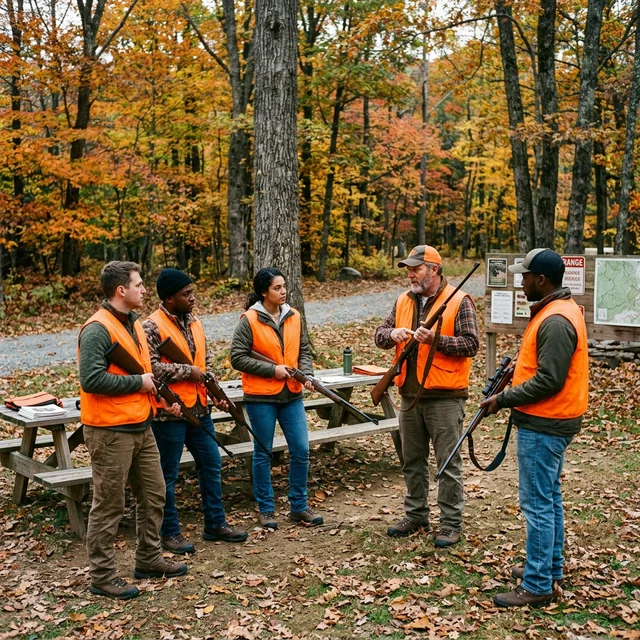
Traditional classroom instruction with a hands-on field day. Benefits:

  • Interactive learning — Ask questions, get immediate feedback
  • Hands-on practice — Live-fire exercises and field skills
  • Often free — Many states offer free in-person courses taught by volunteer instructors
  • Social — Meet other new hunters and potential mentors

Duration is typically 8-16 hours spread over one or two weekends.

Hybrid Courses

Combines online study with a shorter in-person field day:

  • Complete 6-8 hours of online modules at home
  • Attend a 3-4 hour in-person skills session
  • Best of both worlds — saves time while including hands-on components

State-by-State Cost Comparison

Hunter education costs vary significantly by state:

Free States

Several states offer completely free hunter education:

  • Pennsylvania — Free in-person courses statewide
  • Michigan — Free courses online and in-person
  • Minnesota — Free classroom courses
  • Wisconsin — Free volunteer-taught courses

Low Cost ($10-$20)

  • New York — $10 online, free in-person
  • Ohio — Free in-person, $15 online
  • Virginia — $15 online

Standard Cost ($20-$35)

  • Texas — $15 for online content + $15 in-person field day
  • Colorado — $25 online
  • Montana — $19.50 online
  • California — $25 online

Taking the Course: What to Expect

Online Course Structure

Most online courses follow this progression:

  1. Introduction to Hunting — History, conservation, hunter's role
  2. Firearms Safety — Types of firearms, ammunition, safe handling (this is the longest section)
  3. Archery and Crossbow Safety — Bowhunting equipment and safety
  4. Wildlife Management — Species identification, habitat, population management
  5. Hunting Laws and Ethics — Regulations, fair chase, landowner relations
  6. Field Safety — Treestand safety, survival, first aid, hunting with others
  7. Game Care — Field dressing, meat handling, trophy care
  8. Final Exam — Must score 80% or higher to pass (you can usually retake it)

Tips for Passing

  • Don't rush — Actually read the material. Some states have minimum time requirements per module.
  • Take notes on regulations — these are the trickiest test questions.
  • Focus on firearm safety — The four rules of safe gun handling are heavily tested.
  • Review the glossary — Know the difference between terms like "action," "bore," and "chamber."

After You Pass: Your Certificate

What You Receive

Upon successful completion, you'll receive a hunter education certificate (also called a hunter safety card). This may be:

  • A physical card mailed to you
  • A digital certificate you can print or save to your phone
  • A number recorded in the state's licensing database

Certificate Reciprocity

Most states accept hunter education certificates from other states through reciprocity agreements coordinated by the IHEA-USA. If you completed hunter education in Texas, you can typically use that certificate to buy a license in Colorado.

Important: While reciprocity is the norm, a few states may have additional requirements for out-of-state certificates — such as requiring an in-person field day or a state-specific supplemental exam. Always contact the fish and wildlife agency of the state where you plan to hunt to confirm they will accept your certificate without additional steps.

Keeping Your Certificate Safe

  • Photograph both sides of your physical card
  • Record your certificate number in a safe place
  • Register it in your state's online licensing system
  • If lost, contact your state agency for a replacement (usually $5-$10)

Hunter Education for Youth

Age Considerations

  • Most courses are designed for ages 10 and up
  • Parents should attend with younger children for support and shared learning
  • Some states require a parent or guardian to be present during the field day for minors
  • Youth-specific courses are available in many areas, often at no cost
  • Many states allow kids to take the online portion at home and complete the field day on a weekend

Mentored Youth Programs

Several states allow youth to hunt under adult supervision without completing hunter education:

  • Pennsylvania Mentored Youth Program — Ages 7+ can hunt with a licensed adult mentor
  • Michigan Mentored Youth Program — Under 10 with licensed adult
  • These are temporary — Most states still require completing hunter education before hunting independently

Frequently Debated Questions

Is Online or In-Person Better?

Both have advantages. Online is more convenient and fits busy schedules. In-person offers hands-on practice and social connections. If you have zero firearms experience, the in-person field day component is strongly recommended.

How Long Is the Certificate Valid?

For life. Once you pass, you never need to retake the course. Some states may require you to carry your certificate while hunting, or at least have your certificate number on file with the licensing system.

Can I Take Hunter Education from a Different State?

Yes, but take it from the state where you plan to hunt first, as a few states don't accept out-of-state certificates. Otherwise, take it from whichever state offers the most convenient option for you.

Bowhunter Education — A Separate Requirement

Some states require a separate bowhunter education course in addition to standard hunter education before you can purchase an archery hunting license:

States Requiring Bowhunter Education

  • Connecticut — Required for all bowhunters
  • New York — Required for first-time bowhunters
  • Rhode Island — Required for all bowhunters
  • Vermont — Required for first-time bowhunters
  • Montana — Required for some archery seasons

What Bowhunter Education Covers

  • Archery equipment selection and maintenance
  • Shot placement and anatomy for ethical kills
  • Blood trailing and game recovery
  • Tree stand safety specific to bowhunting
  • Distance estimation (critical for archery accuracy)
  • Broadhead safety and handling

Course Details

  • Duration: 6–10 hours (shorter than general hunter education)
  • Cost: Free to $25 depending on state and format
  • Online options: Available in some states through Bowhunter-Ed.com
  • Certificate: Valid for life, reciprocity through IBEP (International Bowhunter Education Program)

Important: In most states, bowhunter education is NOT required — standard hunter education is sufficient for archery hunting. Only the states listed above mandate it. However, even where it's not required, bowhunter education is strongly recommended for anyone new to archery hunting.

Specialty Hunter Education Courses

Beyond basic hunter education, several specialized courses are available:

Trapper Education

  • Required in many states before purchasing a trapping license
  • Covers trap types, setting techniques, animal welfare, fur handling
  • Typically 6–8 hours, often free through state agencies
  • States requiring trapper education: New York, Connecticut, Massachusetts, New Jersey, and others

Waterfowl Identification

  • Not legally required but offered by many states and DU chapters
  • Covers species identification, flyway biology, and regulations
  • Particularly valuable for new waterfowl hunters who need to identify species in low-light conditions

Turkey Hunting Safety

  • Offered by NWTF (National Wild Turkey Federation) and state agencies
  • Covers calling safety, shot identification, and spring hunting hazards
  • Turkey hunting has unique safety concerns because hunters wear camouflage and mimic game sounds

Advanced Hunter Education / Master Hunter

  • Washington — Master Hunter Permit program provides access to special hunts
  • Oregon — Master Hunter program with advanced training and testing
  • These programs offer additional hunting opportunities as incentives for advanced training

Taking Time Off Work or School for Hunter Education

Some states have provisions that support hunter education attendance:

Youth / School Excuses

  • Several states recognize hunter education as an excused absence from school
  • Wisconsin — Students may be excused for hunter education and hunting days
  • Pennsylvania — School districts may excuse students for hunter education
  • Michigan — Hunter education courses are offered in some school districts as part of the curriculum
  • Check your school district's policy — many rural districts are accommodating

Adult / Employer Considerations

  • No federal requirement for employers to grant time off for hunter education
  • However, online self-paced courses eliminate the need for time off entirely
  • Complete modules during evenings, lunch breaks, or weekends
  • The hybrid format minimizes in-person time to a single 3–4 hour field day (often held on weekends)

International Hunter Education Equivalency

If you completed hunting education in another country:

  • Canada — Canadian hunter education certificates are widely accepted in the US through IHEA reciprocity
  • Europe — Some states accept European hunting certificates (Jagdschein from Germany, etc.) on a case-by-case basis
  • Other countries — Acceptance varies significantly by state. Some states accept foreign certificates, others require you to complete a US course
  • Best approach: Contact the specific state wildlife agency where you plan to hunt. Bring your international certificate and any documentation of completion

For international visitors who don't have recognized hunter education, many states waive the requirement if you hire a licensed guide or outfitter. This is the simplest path for foreign hunters visiting the US.

See our International Hunters Guide to the USA for complete details on hunting in America as a foreign visitor.

Keep Reading

Frequently Asked Questions

How long does hunter education take?

The time required for hunter education varies by format and state, but most courses take 6-16 hours total to complete. Online courses typically require 6-8 hours of self-paced study that you can spread over several days or weeks, allowing you to complete modules on your own schedule from home using any device. You can pause and resume at any time, making online courses ideal for busy schedules. In-person classroom courses are more intensive, typically requiring 8-16 hours of instruction spread over one or two weekends (often Saturday and Sunday, 8am-5pm each day). These include both classroom instruction and hands-on field exercises with live firearms and archery equipment. Hybrid courses combine the convenience of online study (6-8 hours at home) with a shorter mandatory in-person field day (3-4 hours) where you demonstrate practical skills like safe firearm handling, shooting fundamentals, and field safety techniques. Some states like California require all online students to complete a mandatory 4-hour in-person field day regardless of age. The actual time varies by individual: if you have prior firearms experience, you may move through the material faster, while complete beginners should budget extra time to thoroughly understand safety concepts. Most online courses have minimum time requirements per module (typically 15-30 minutes) to prevent rushing through critical safety information. The final exam usually takes 30-60 minutes and requires an 80% passing score, though you can retake it if needed. After passing, you'll receive your certificate within 1-7 days depending on whether it's digital (immediate) or physical (mailed). Plan to start your hunter education at least 2-3 weeks before you need your hunting license to allow time for completion and certificate processing.

Is hunter education really required?

Yes, hunter education is legally required for first-time hunters in 49 out of 50 states before you can purchase a hunting license, with only a few narrow exceptions. The requirement applies regardless of your age in most states — even adults in their 40s, 50s, or older must complete hunter education if they've never held a hunting license before. However, there are several important exceptions and alternatives to understand. Birth date exemptions: Many states exempt hunters born before certain dates from hunter education requirements, recognizing that these individuals learned to hunt before mandatory programs existed. Common exemption dates include born before January 1, 1972 (Washington), born before September 2, 1971 (Texas), born before July 1, 1980 (Pennsylvania), and born before January 1, 1967 (Missouri). If you were born before your state's cutoff date, you can purchase a hunting license without completing hunter education. Apprentice/mentored hunting programs: Over 40 states offer temporary alternatives that allow you to hunt under the direct supervision of a licensed adult mentor without completing hunter education first. These programs are typically limited to 1-3 years (Pennsylvania allows 3 years for ages 12+, Montana allows 2 license years, Missouri allows annual renewable authorization), after which you must complete hunter education to continue hunting independently. Active duty military: A small number of states waive hunter education requirements for active-duty military personnel, though this is rare and military service does not exempt you in most states. Previous license holders: If you held a valid hunting license in any state in a previous year, most states will issue you a license without requiring hunter education, even if you let your license lapse for several years. Out-of-state certificates: All states accept hunter education certificates from other states through IHEA-USA reciprocity agreements, so you only need to complete the course once in your lifetime. The requirement exists because hunter education has been remarkably effective at reducing hunting accidents — the International Hunter Education Association reports a greater than 50% nationwide reduction in hunting-related incidents since mandatory education was widely adopted, with some states like Wisconsin seeing a 96% reduction since 1967.

Can I complete hunter education entirely online?

Whether you can complete hunter education entirely online depends on your state and age, as requirements vary significantly across the country. Many states allow fully online completion for adults (typically age 17, 18, or older), meaning you can complete all coursework and the final exam from home without any in-person requirements. States offering 100% online options for adults include Texas (age 17+), Montana, Colorado, Ohio, Virginia, and many others. However, a significant number of states require all students — or at least youth under a certain age — to attend a mandatory in-person field day even if the coursework is completed online. California is the strictest, requiring all online students regardless of age to complete a mandatory 4-hour in-person field day covering live-fire exercises, safe gun handling demonstrations, and practical skills assessment. New York requires youth under 18 to attend an in-person field day. Pennsylvania offers free in-person courses but also accepts fully online certification from approved providers. The in-person field day typically lasts 3-4 hours and covers hands-on skills that cannot be adequately taught online: safe firearm handling and carry techniques, live-fire shooting exercises with instructor supervision, proper shooting positions and stances, safe crossing of obstacles like fences and streams, and emergency response scenarios. Some states allow you to complete the field day in any state, not just your home state, which can be convenient if you're traveling or have limited local options. A few states like New Jersey, Connecticut, and Massachusetts have very limited online options and strongly prefer or require traditional in-person classroom courses. To determine your state's specific requirements, visit your state wildlife agency's hunter education page or check with approved providers like Hunter-Ed.com which clearly indicates whether your state requires a field day. If you have zero firearms experience, even if your state allows 100% online completion, it's strongly recommended to attend an in-person field day or traditional classroom course to gain hands-on practice under instructor supervision before handling firearms in the field.

Does my hunter education certificate expire?

No, hunter education certificates are valid for life and never expire. Once you successfully complete an approved hunter education course and receive your certificate, you never need to retake the course regardless of how many years pass between hunting seasons. This lifetime validity applies to certificates earned in any state and remains valid even if you move to a different state, as all states recognize certificates from other states through IHEA-USA (International Hunter Education Association) reciprocity agreements. Your certificate remains valid even if the physical card is lost or damaged — your completion is recorded in state databases and you can request a replacement certificate (typically $5-$10 fee) from the state that issued it. Some states issue physical plastic cards similar to driver's licenses, while others provide paper certificates or digital certificates that you can save to your phone. Regardless of format, the certification itself never expires. However, there are important practical considerations: some states require you to carry your physical certificate or have your certificate number available while hunting, so game wardens can verify your certification during field checks. Most states now integrate your hunter education certificate number into their online licensing systems, so when you purchase a hunting license, your certification is automatically verified and linked to your license. If you completed hunter education decades ago and cannot locate your certificate, contact the wildlife agency in the state where you took the course — they can look up your completion record and issue a replacement. Keep your certificate number recorded in a safe place (take a photo of both sides of your card and store it in cloud storage) to make future license purchases easier. While the certificate never expires, hunting regulations, seasons, and bag limits change frequently, so it's your responsibility to review current regulations each year before hunting even though your certification remains valid. Some hunters choose to take refresher courses voluntarily after many years away from hunting, though this is not required.

What happens if I fail the hunter education exam?

If you fail the hunter education final exam, you can retake it — most courses allow unlimited retake attempts until you pass, though the specific retake policies vary by course format and provider. Online courses typically offer the most flexible retake options: you can review the material immediately and retake the exam right away, often with no waiting period or additional fee. Most online providers like Hunter-Ed.com allow you to review your incorrect answers, study the relevant sections again, and retake the exam as many times as needed until you achieve the required 80% passing score. Some online courses generate slightly different questions on each attempt to ensure you're learning the material rather than memorizing specific answers. In-person classroom courses handle retakes differently: if you fail the written exam at the end of the course, the instructor will typically allow you to review the material and retake it the same day or return for a makeup exam on a later date. Some instructors offer one-on-one tutoring for students who struggle with specific concepts. The field day practical skills assessment is usually pass/fail based on safe handling demonstrations — if you fail to demonstrate safe firearm handling, you'll receive additional instruction and coaching until you can perform the skills correctly. Most instructors are very patient and want you to succeed, so they'll work with you until you demonstrate competency. The passing score is typically 80% on the written exam, meaning you can miss 20% of questions and still pass. Common reasons for failing include rushing through the material without reading carefully, not understanding firearm terminology and parts, confusing hunting regulations between different states or species, and not studying the four fundamental rules of firearm safety which are heavily tested. To improve your chances of passing on the first attempt: take your time reading each module thoroughly, take notes on key concepts especially firearm safety rules and regulations, review the glossary to understand terminology, use the practice quizzes available in most online courses, and don't attempt the final exam until you feel confident in the material. If you do fail, don't be discouraged — use it as a learning opportunity to identify weak areas and study those sections more carefully before retaking.

How much does hunter education cost?

Hunter education costs vary dramatically by state and course format, ranging from completely free to approximately $35 depending on where you live and which option you choose. Several states offer completely free hunter education through volunteer-taught programs: Pennsylvania provides free in-person courses statewide taught by certified volunteer instructors, Michigan offers free courses both online and in-person, Minnesota provides free classroom courses, Wisconsin offers free volunteer-taught courses, and the NRA Online Hunter Education program is 100% free in participating states. These free options provide the same certification as paid courses and are fully recognized by all states through reciprocity agreements. Low-cost states ($10-$20) include New York ($10 online, free in-person), Ohio (free in-person, $15 online), Virginia ($15 online), and several others. Standard-cost states ($20-$35) represent the majority: Texas charges $15 for online content plus $15 for the mandatory in-person field day (total $30), Colorado charges $25 online, Montana charges $19.50 online, California charges $25 online plus requires a mandatory 4-hour field day, and most other states fall in the $24.50-$34.50 range through providers like Hunter-Ed.com. The cost typically covers all course materials, online access, practice quizzes, the final exam, and your official certificate (either digital or physical card mailed to you). Some states charge a small additional fee ($5-$10) for replacement certificates if you lose your original. In-person courses are often free because they're taught by volunteer instructors, but you may need to provide your own lunch and transportation to the course location (typically held at wildlife agency offices, shooting ranges, or community centers). Hybrid courses that combine online study with in-person field days typically cost the same as fully online courses in states that require field days. If cost is a concern, check whether your state offers free in-person courses before paying for online options, or look for the NRA Online Hunter Education program which is completely free. Remember that hunter education is a one-time expense — your certificate is valid for life and recognized in all 50 states, so even a $35 course pays for itself immediately when you consider it enables you to hunt for the rest of your life.

Can I take hunter education in a different state?

Yes, you can take hunter education in any state regardless of where you live or plan to hunt, and your certificate will be recognized by all other states through IHEA-USA (International Hunter Education Association) reciprocity agreements. This flexibility allows you to choose the most convenient, affordable, or accessible option for your situation. For example, if you live in California (which requires a mandatory 4-hour in-person field day for all online students) but want to avoid the field day requirement, you could complete a fully online course from a state like Texas or Montana that allows 100% online completion for adults, and California would still accept your certificate. If you live in a state with expensive online courses, you could take the free NRA Online Hunter Education program or choose a state with lower-cost options. However, there are important considerations and best practices to follow. It's generally recommended to take hunter education from the state where you plan to hunt first, because a small number of states have additional requirements for out-of-state certificates such as supplemental exams or mandatory field days. While reciprocity is the norm and most states accept all IHEA-approved certificates without question, it's safer to start with your primary hunting state to avoid potential complications. If you're taking an online course from a different state, make sure the provider is IHEA-approved and that the certificate will be recognized nationwide — reputable providers like Hunter-Ed.com clearly indicate which states accept their courses. Some states maintain their own online platforms (Texas, California, New York) that may be less expensive than third-party providers, and these state-issued certificates are universally accepted. When purchasing your hunting license, you'll need to provide your hunter education certificate number regardless of which state issued it — most states now integrate this into their online licensing systems so verification is automatic. Keep in mind that while your certificate is valid everywhere, you must still comply with each state's specific hunting regulations, seasons, bag limits, and additional licensing requirements when you hunt there. If you're planning to hunt in multiple states regularly, taking hunter education from any IHEA-approved provider gives you lifetime access to hunting in all 50 states, making it one of the best values in outdoor recreation.

Do I need hunter education if I already have a firearms license or concealed carry permit?

Yes, in almost all states you still need to complete hunter education even if you hold a firearms license, concealed carry permit (CCW/CHL), or have extensive firearms training through military service, law enforcement, or competitive shooting. Hunter education and firearms licensing are separate requirements that serve different purposes and are not interchangeable. Firearms licenses and concealed carry permits focus primarily on safe gun handling, self-defense laws, and responsible concealed carry in public spaces, while hunter education covers a much broader curriculum including wildlife identification and conservation, hunting ethics and fair chase principles, game laws and regulations specific to hunting, field dressing and game care, treestand safety and hunting-specific scenarios, survival skills and outdoor emergency preparedness, and the hunter's role in wildlife management and conservation funding. The skills and knowledge required for safe concealed carry in urban environments are fundamentally different from those needed for ethical and safe hunting in the field. However, there are a few narrow exceptions: some states offer abbreviated hunter education courses or "challenge exams" for individuals who can demonstrate extensive firearms proficiency through military service, law enforcement training, or NRA instructor certifications, though you must still pass a hunter education exam covering wildlife and hunting-specific topics. A handful of states waive hunter education for active-duty military, though this is rare and most states still require it. If you held a valid hunting license in any state in a previous year, most states will issue you a new license without requiring hunter education even if you let it lapse. Birth date exemptions apply in many states — hunters born before certain dates (typically 1960s-1970s) are exempt from hunter education regardless of other credentials. Your concealed carry permit or firearms training may make the hunter education course easier since you'll already understand firearm safety fundamentals, but you'll still need to learn the hunting-specific content including species identification, bag limits, legal hunting methods, and conservation principles. Most hunters with firearms experience find hunter education courses straightforward and can complete online courses in 6-8 hours. The one-time investment in hunter education (free to $35 depending on state) provides lifetime certification valid in all 50 states, making it a worthwhile requirement even for experienced shooters.