
California Bear Hunting 2026: No Dogs, 1,700 Quota, Spot-and-Stalk Tactics & Best Zones
How to hunt black bears in the only western state that bans dogs — mastering spot-and-stalk in California's diverse terrain.
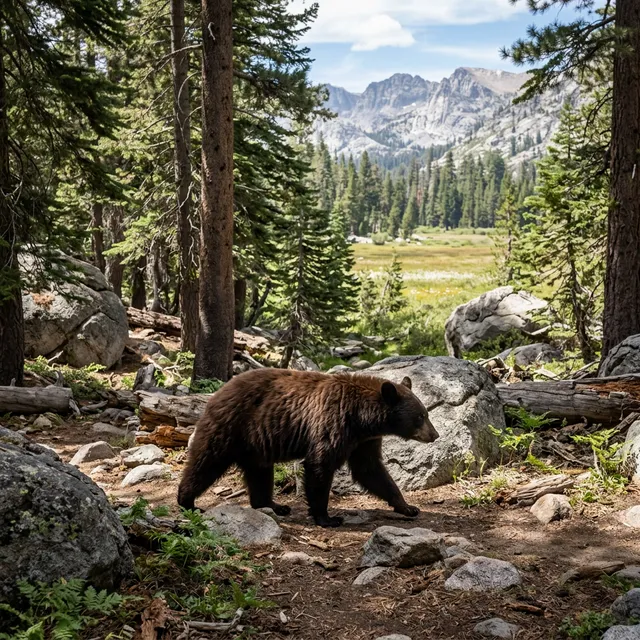
Planning Notes
- California has approximately 25,000–40,000 black bears — hunting is open but limited by a statewide 1,700 bear quota.
- Hunting bears with dogs was banned in 2013 — all bear hunting in California is spot-and-stalk or stand hunting.
- Resident bear tags cost $63.17; non-resident bear tags are $399.68 (2026-2027 season).
- Archery season opens August 15; general season runs concurrently with deer zones through December 27.
- Baiting bears is illegal. Non-lead ammunition is mandatory statewide.
In This Guide 10 sections
- California Bear Hunting: A Unique Challenge
- Season Structure and Dates
- License and Tag Requirements
- Why the Dog Ban Changed Everything
- Spot-and-Stalk: The Only Way to Hunt Bears in California
- Best Bear Hunting Zones
- Reporting and Validation Requirements
- Bear Safety and Field Care
- Non-Resident Bear Hunting in California
- California Bear Hunting FAQ
California Bear Hunting: A Unique Challenge
California's bear hunting program is unlike any other western state. The combination of a statewide ban on using dogs, a prohibition on baiting, and mandatory non-lead ammunition creates a uniquely challenging hunting experience that rewards patience, glassing skills, and physical fitness.
Despite these restrictions, California holds one of the largest black bear populations in the West — an estimated 25,000 to 40,000 animals spread from the Oregon border south through the Sierra Nevada, Cascade Range, and coastal mountains. The population has actually increased since the dog ban took effect, as harvest numbers dropped significantly.
Key Facts That Set California Apart
- No dogs allowed — Banned by voter-approved Proposition 96 in 2012, taking effect in 2013
- No baiting — It is unlawful to use feed or bait to attract bears
- 1,700 bear quota — Season closes early if the statewide harvest reaches 1,700 bears (includes archery and general seasons)
- Non-lead ammunition required — All projectiles must be certified non-lead
- Cubs and sows with cubs protected — It is illegal to take cubs or female bears accompanied by cubs
- One bear per year — Limit of one adult bear per hunting license year
Season Structure and Dates
California offers both archery and general bear seasons, with dates that align closely with deer hunting seasons.
Archery Bear Season
- Dates: August 15 – September 6, 2026
- Zones: All bear zones statewide
- Methods: Bow and arrow only (compound, recurve, longbow with broadheads)
- Advantage: Less hunting pressure, bears are active in late summer, berries and acorns are plentiful
General Bear Season
- Group 1: Opens concurrently with general deer season in zones A, B, C, D, X8, X9A, X9B, X10, and X12 — runs through December 27
- Group 2: Zones X1, X2, X3a, X4, X6a, X6b, X7a, and X7b open October 10 through December 27
- Methods: Rifle, shotgun, muzzleloader, bow — all with non-lead ammunition
The 1,700 Bear Quota
The entire bear season (archery and general combined) is subject to a statewide harvest quota of 1,700 bears. If CDFW determines this quota has been reached, the season closes early via public notice. In practice, the quota has not been reached since the dog-hunting ban took effect in 2013 — annual harvest has typically remained below 1,200 bears.
License and Tag Requirements
| Item | Resident Cost | Non-Resident Cost | Notes |
|---|---|---|---|
| Hunting License (Base) | $62.90 | $219.81 | Valid July 1 – June 30 |
| Bear Tag | $61.30 | $387.85 | One per license year |
| Junior License (Under 16) | $16.46 | $16.46 | Big game: age 12+ only |
| Hunter Education | Required | Required | One-time; reciprocity accepted |
Total Cost Breakdown
| Scenario | Resident | Non-Resident |
|---|---|---|
| Bear tag only (base license + tag) | $124.20 | $607.66 |
| Bear + Deer combo | $165.50 | $975.86 |
| Bear + Deer + Wild Pig | $193.07 | $1,074.71 |
Adding a deer tag and wild pig validation to your bear trip makes excellent economic sense — you're already in the field and licensed.
Why the Dog Ban Changed Everything
Understanding the dog ban is essential context for California bear hunters. Prior to 2013, using trained hound packs to track, tree, and bay black bears was the dominant hunting method in California, as it is in most bear hunting states.
Before the Ban (Pre-2013)
- Annual bear harvest averaged 1,500–1,800 bears
- Success rates for dog hunters were 60–80%
- The season frequently reached or approached the quota
- Dog-assisted hunting was the primary method for 80%+ of successful hunters
After the Ban (2013–Present)
- Annual harvest dropped to approximately 800–1,200 bears
- Success rates for spot-and-stalk hunters are estimated at 10–20%
- The 1,700 quota has not been reached in any year since the ban
- Bear population has grown, with increased human-bear conflicts in suburban areas
The Political Context
The ban was driven by Proposition 96 (later implemented through SB 1221 in 2012), supported by animal welfare organizations that argued hound hunting was inhumane. Opponents, including CDFW biologists and hunting organizations, argued the ban would hamper bear population management. Both predictions have largely proven accurate — the bear population has grown, and urban conflicts have increased.
Spot-and-Stalk: The Only Way to Hunt Bears in California
Without dogs, California bear hunters must rely on their own skills to locate, approach, and harvest bears. Here's how to be effective.
Glassing Strategy
The most productive method for finding bears is extensive glassing of oak woodland hillsides, berry patches, and meadow edges during morning and evening feeding periods.
Prime glassing times:
- Morning: First light to 2 hours after sunrise — bears feed actively on slopes
- Evening: 3 hours before sunset to last light — bears emerge from day beds to feed
- Mid-day: Generally unproductive; bears bed in dense cover during heat
What to glass for:
- Open oak stands on hillsides (acorn season: September–November)
- Berry patches — manzanita, elderberry, and blackberry thickets
- Meadow edges where bears graze on grass and forbs (early season)
- Logged areas with new growth and exposed stumps (bears dig for grubs)
Approach and Stalk Tactics
Once you've located a bear via glassing:
- Mark its position precisely — Use landmarks and GPS to fix the bear's location
- Plan your approach — Use terrain features (ridges, draws, timber) to stay hidden
- Watch the wind — Bears have exceptional noses; wind direction is the #1 factor in stalk success
- Move slowly — A 500-yard stalk might take 1–2 hours; patience is rewarded
- Get close — Most successful stalks end at 100–200 yards for rifle or 30–40 yards for archery
- Positively identify — Confirm no cubs are present before shooting; take the time to watch
Stand Hunting Over Natural Food Sources
An alternative to spot-and-stalk is setting up a treestand or ground blind near a natural food source. Remember, baiting is illegal — you can only hunt over naturally occurring food.
Effective natural food sources:
- Oak trees dropping acorns (September–November is prime)
- Berry thickets along drainage bottoms
- Apple and pear orchards adjacent to wildlands (with landowner permission)
- Garbage-exposed areas near campgrounds on public land (legal but ethically controversial)
Best Bear Hunting Zones
Northern Sierra and Cascades
The Shasta, Lassen, and Plumas county regions support some of California's highest bear densities. The Cascade Range and northern Sierra offer excellent habitat with mixed conifer forests, oak woodlands, and abundant berry patches.
Key public lands:
- Shasta-Trinity National Forest
- Plumas National Forest
- Lassen National Forest
Central Sierra
The Sierra Nevada from El Dorado County south to Mariposa County offers good bear habitat in the transition zone between foothill oak woodland and montane forest (3,000–7,000 feet elevation).
Key public lands:
- Eldorado National Forest
- Stanislaus National Forest
- Sierra National Forest
Northwestern California
Trinity, Humboldt, and Mendocino counties offer dense coastal mountain habitat where bears thrive in mixed conifer and hardwood forests.
Key public lands:
- Six Rivers National Forest
- Mendocino National Forest
- Trinity Alps Wilderness
Reporting and Validation Requirements
California has strict post-harvest requirements for bears:
- Immediate tagging — Attach your bear tag to the animal immediately after harvest
- CDFW validation — You must have your bear tag validated by a CDFW employee before transporting the bear, except when taking it directly to the nearest authorized validator
- Premolar tooth collection — A premolar tooth must be collected during tag validation for biological data (age determination)
- Retain skin and ears — You must keep the bear's skin and the portion of the head bearing the ears for 15 days following the close of the season
- Harvest report — All bear tag holders (successful or not) must submit a harvest report by February 1 of the following year
- Failure to report — Not reporting or not returning your tag is a violation subject to citation
Bear Safety and Field Care
Shot Placement
Bears have dense muscle, thick hides, and a heavy skeletal structure that protects vital organs. Proper shot placement is critical:
- Broadside: Place the shot behind the front shoulder, one-third up from the belly line — this accesses heart and lungs
- Quartering away: Aim to place the bullet through the off-side shoulder for maximum penetration through vital organs
- Avoid head shots: Bear skulls are thick and angled; head shots frequently result in wounded, unrecoverable animals
- Wait after the shot: Bears can travel significant distances after a fatal hit. Wait at least 30 minutes before trailing
Field Dressing
- Bears spoil faster than deer due to thick fur insulating body heat — field dress immediately
- Remove the hide as quickly as possible to cool the meat
- In warm weather, quarter the bear and get meat on ice within 2 hours
- Bear meat must be cooked thoroughly — trichinella can be present in bear muscle tissue (internal temp: 160°F / 71°C minimum)
- Bear fat is highly prized for cooking — render and save it separately
Non-Resident Bear Hunting in California
Bear hunting in California is an excellent non-resident opportunity because:
- No draw required — Bear tags are available over-the-counter
- No preference points needed — Buy your tag and go
- Long season — August through December gives flexible scheduling
- Combinable — Hunt bears alongside deer in overlapping seasons
Tips for Non-Resident Bear Hunters
- Combine with deer — An OTC D-zone deer tag plus bear tag makes an efficient multi-species trip
- September–October is best — Bears are actively feeding on acorns and berries, temperatures are moderate
- Bring quality optics — A spotting scope and high-quality binoculars are essential for glassing
- Non-lead ammo preparation — Sight in thoroughly with certified non-lead ammunition before your trip
- Fitness matters — California bear country is steep and rugged; be in good physical condition
- Consider hiring a guide — Local knowledge of bear feeding patterns and terrain is invaluable for a first-time California bear hunter
California Bear Hunting FAQ
- California Deer Hunting 2026: Complete Guide to Zones, Tags, Draw System & Best Regions Complete California deer hunting guide for 2026. Learn about zones A–X, preferen…
- California Wild Pig Hunting: Year-Round Season, No Bag Limit — Complete 2026 Guide Everything you need to hunt wild pigs in California — year-round season, no bag …
- Hunting on Public Land: License, Access, and Property Rules Use this public-land workflow to separate state hunting licenses, BLM and nation…
Frequently Asked Questions
Can I use dogs to hunt bears in California?
No. Using dogs to track, tree, bay, or chase bears has been illegal in California since 2013 following Proposition 96 and SB 1221. All bear hunting must be done via spot-and-stalk, stand hunting over natural food sources, or calling.
How much does a California bear tag cost?
A resident bear tag costs $63.17 and a non-resident bear tag is $399.68 for the 2026-2027 season. This is in addition to the base hunting license ($64.82 resident, $226.40 non-resident).
What is the bear harvest quota in California?
The statewide quota is 1,700 bears (archery and general seasons combined). If the quota is reached, the season closes early. Since the dog-hunting ban in 2013, the quota has not been reached — annual harvest has been approximately 800–1,200 bears.
When is the best time to hunt bears in California?
September through early November is generally the most productive period. Bears are actively feeding on acorns, berries, and preparing for winter denning. Early morning and late evening are the best times of day for glassing and stalking.
Can I bait bears in California?
No. Using feed or bait to attract bears for hunting is illegal in California. You can only hunt bears over naturally occurring food sources like oak groves, berry patches, or meadows. Setting out any food or attractant is a citable offense.
Do I need a draw tag for bear hunting in California?
No. California bear tags are available over-the-counter (OTC) for both residents and non-residents. No preference points or draw application needed — just purchase your license and bear tag and you're ready to hunt.
Is bear meat safe to eat?
Yes, bear meat is excellent eating when properly handled. All bear meat must be cooked to an internal temperature of at least 160°F (71°C) to kill trichinella parasites, which can be present in bear muscle tissue. Never eat raw or undercooked bear meat.
How big are California black bears?
Adult male (boar) California black bears typically weigh 200–400 pounds, with exceptional individuals exceeding 500 pounds. Females (sows) typically range 125–250 pounds. Bears in the Sierra Nevada tend to be larger than coastal bears due to abundant food sources.