
Pennsylvania Bear Hunting: Season Dates, Tags & Top Counties for Black Bear
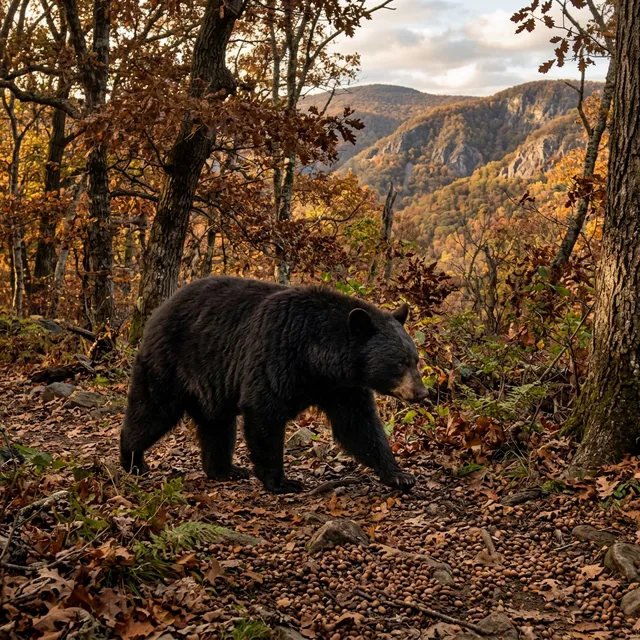
Hunt one of the densest black bear populations in the eastern U.S. — with an estimated 20,000+ bears across the Keystone State.
Planning Notes
- Pennsylvania has an estimated 20,000+ black bears — one of the largest populations in the eastern United States.
- Bears were harvested in 58 of PA's 67 counties during recent seasons, demonstrating the species' expanding range.
- The 2026-2027 bear season includes archery (Oct 17–24), muzzleloader (Oct 17–24), regular firearms (Nov 21–24), and extended firearms (Nov 21 – Dec 5 in select WMUs).
- A resident bear license costs $16.97 in addition to the $20.97 general hunting license. Non-residents pay $36.97.
- Top harvest counties include Tioga, Lycoming, Potter, Pike, Bradford, and Luzerne — the Northern Tier dominates.
- Sunday hunting is now available on approved dates, adding new opportunity for bear hunters.
In This Guide 7 sections
PA's Growing Black Bear Population
Pennsylvania's black bear success story is one of the most impressive wildlife management achievements in the eastern United States. Once confined to the remote mountains of the north-central and northeast regions, black bears have expanded dramatically across the Keystone State over the past several decades.
Population Growth
| Decade | Estimated Population | Trend |
|---|---|---|
| 1970s | ~4,000 | Limited to core mountain range |
| 1990s | ~10,000 | Expanding south and east |
| 2010s | ~16,000-18,000 | Established in 50+ counties |
| 2020s | ~20,000+ | Bears present in 58+ counties |
This growth reflects:
- Excellent habitat — PA's 17 million acres of forest (58% of the state is forested) provide ideal black bear habitat
- Sound management — The PGC uses season structure and WMU-based quotas to maintain healthy, sustainable populations
- Adaptability — Black bears have expanded into agricultural and suburban areas across the southern tier, Poconos, and even parts of the southeast
Why PA Bear Hunting Matters
Bear hunting is the primary management tool for keeping Pennsylvania's expanding bear population in balance with available habitat and public tolerance. Without regulated hunting, bear-human conflicts would increase significantly — crop damage, livestock depredation, garbage raiding, and vehicle collisions all rise when bear populations exceed carrying capacity.
The annual harvest typically ranges from 3,000 to 4,000+ bears, with recent seasons trending toward the higher end as the population continues to grow.
2026-2027 Bear Season Dates
Pennsylvania offers multiple bear seasons, giving hunters flexibility in weapon choice and timing. The season structure is more complex than many states, with some dates varying by Wildlife Management Unit (WMU).
Season Calendar
| Season | Dates | WMUs | Method |
|---|---|---|---|
| Archery (statewide) | Oct 17 – 24, 2026 | All WMUs | Archery only |
| Archery (extended) | Sep 19 – Nov 20, 2026 | 2B, 5C, 5D | Archery only |
| Archery (extended) | Oct 3 – Nov 20, 2026 | 5B | Archery only |
| Muzzleloader | Oct 17 – 24, 2026 | Statewide | Muzzleloader only |
| Special Firearms | Oct 22 – 24, 2026 | Statewide | Junior, Senior, Mentored, Military, Disabled |
| Regular Firearms | Nov 21 – 24, 2026 (incl. Sun Nov 22) | Statewide | Any legal weapon |
| Extended Firearms | Nov 21 – Dec 5, 2026 (incl. Sun Nov 22) | 2B, 3A-3D, 4C, 4E, 5A-5D | Any legal weapon |
Understanding the Season Structure
The staggered approach serves important management goals:
- Archery season (Oct 17–24 statewide): Gives bowhunters a low-pressure window. Bear harvest during archery is typically modest but provides a unique challenge
- Muzzleloader & Special Firearms overlap (Oct 17–24): Creates a 3-day window where multiple weapon types are in play
- Regular firearms (Nov 21–24): The main event — four intense days that typically produce the majority of the annual harvest. This timing coincides with pre-denning activity when bears are actively feeding
- Extended firearms (Nov 21 – Dec 5): Available only in select WMUs with higher bear densities. This extension significantly increases harvest opportunity in areas where the PGC is trying to stabilize or reduce bear numbers
Sunday Hunting Impact
With Act 36 of 2025 repealing the Sunday hunting ban, bear hunters now benefit from approved Sunday dates. Sunday November 23 falls during the regular firearms bear season, and Sunday November 30 falls during the extended firearms period — adding meaningful days to what was historically a very brief season.
Bear License & Tag Requirements
License Costs
| License | Resident | Non-Resident |
|---|---|---|
| General Hunting License | $20.97 | $101.97 |
| Bear License (required add-on) | $16.97 | $36.97 |
| Total to hunt bear | $37.94 | $138.94 |
A bear license is issued in addition to your general hunting license. Unlike deer (where your general license includes a buck tag), bear requires a separate purchase. Each bear license includes one bear tag valid statewide during any open bear season.
Bag limit: 1 bear per license year.
Reporting Requirements
- Mandatory check: All harvested bears must be brought to a PGC check station or reporting location within 24 hours of harvest
- Biological data: PGC biologists collect weight, age (via tooth extraction), sex, and reproductive data from each bear at check stations
- This data drives management: The check station program provides the PGC with annual population data used to set season structures and allocations
Best Counties for Black Bear
Top Harvest Counties (Recent Seasons)
| Rank | County | Region | Key Features |
|---|---|---|---|
| 1 | Tioga | Northern Tier | Vast state forest and game lands, consistently #1 or #2 |
| 2 | Lycoming | Northern Tier | Loyalsock State Forest, diverse terrain |
| 3 | Potter | Northern Tier | Remote "God's Country," low hunting pressure |
| 4 | Pike | Northeast | Pocono expansion frontier, growing bear numbers |
| 5 | Bradford | Northern Tier | Large tracts of State Game Lands |
| 6 | Luzerne | Northeast | Bear-human conflict zone, active management |
| 7 | Monroe | Northeast | Pocono Mountains corridor |
| 8 | Clinton | North Central | Sproul State Forest — 305,000 acres of bear country |
| 9 | Elk | North Central | Elk range overlap, remote mountain terrain |
| 10 | Sullivan | Northern Tier | Small county, surprisingly high bear density |
Region-by-Region Analysis
Northern Tier (WMUs 1A, 1B, 2G, 3A): The historic core of PA bear country. These counties feature vast expanses of unbroken forest, low human density, and the state's most robust bear populations. Tioga and Potter counties alone can produce 200+ bears in a single season.
Northeast/Poconos (WMUs 3A, 3B, 3C, 3D): This region has seen dramatic bear population growth as animals push into the suburban-forest interface. Pike and Monroe counties increasingly produce high harvests as bears expand into residential areas.
Central Mountains (WMUs 2G, 2H, 4A, 4B): The Ridge and Valley Province offers excellent bear habitat in large state forest tracts. Sproul, Tioga, and Rothrock State Forests are particularly productive.
Southwest (WMUs 4C, 4E): The newest frontier for PA bears. Somerset, Fayette, and Cambria counties are seeing increasing bear activity as the population expands southward along the Allegheny Front.
Bear Hunting Safety & Field Dressing
Safety Considerations
Black bear hunting in Pennsylvania involves unique safety considerations:
- Size and weight: PA black bears average 200-400 lbs, with mature boars reaching 500+ lbs. The state record bull black bear exceeded 800 lbs. Always be prepared for the physical demands of recovering and processing a large animal
- Shot placement: A bear's thick fur and heavy body can make blood trails difficult. The vital zone is similar to a deer's but positioned slightly more forward and lower. Broadside lung shots are ideal
- Wounded bear protocol: Never approach a downed bear until you are certain it is dead. A wounded bear can be extremely dangerous. Wait at least 30 minutes after the shot before approaching, and poke the animal with a long stick before getting close
- Climbing ability: Bears can run up to 35 mph and are excellent climbers. A tree stand does not provide safety from a bear as it would from a deer
Field Dressing Tips
- Field dress immediately — Bears have a heavy fat layer that insulates heat. Prompt field dressing is critical, especially during the warmer November dates
- Skin as soon as possible — The thick fur acts as insulation and can cause meat spoilage if left on too long
- Cool the meat — Get the carcass to a cool, shaded location or hang it where air can circulate. In warm weather, consider quartering and icing immediately
- Save proof of sex — PA regulations require that proof of sex (genitalia) remain naturally attached to one quarter of the carcass during transport
Bear Meat
Black bear meat is excellent when properly handled. It must be thoroughly cooked (internal temperature of 160°F+) due to the risk of trichinosis. Popular preparations include:
- Slow-cooked roasts and stews (the most forgiving cooking method)
- Ground bear for burgers, sausage, and chili
- Bear bacon (from the belly fat and meat)
- Rendered bear fat for cooking (historically prized)
Non-Resident Bear Hunting in PA
Cost Summary
| Item | Cost |
|---|---|
| Non-Resident General Hunting License | $101.97 |
| Non-Resident Bear License | $36.97 |
| Total | $138.94 |
Why NR Hunters Choose PA for Bear
- No draw or lottery — Unlike many western states (Colorado, Idaho), PA bear tags are over-the-counter
- High population density — With 20,000+ bears, encounters are likely on properly scouted public land
- Extensive public land — No need to lease private property
- Multiple season dates — Choose your preferred season based on weapon type and schedule
- Affordable — Total cost under $140 compares favorably to guided bear hunts in western states ($3,000-$8,000+)
NR Strategy Tips
- Focus on the regular firearms season (Nov 22-25) — Short, high-intensity, and the timing coincides with peak pre-den feeding when bears are most active
- Target Northern Tier counties — Tioga, Potter, Lycoming, and Clinton offer the best combination of bear density and public land access
- Scout mast-producing ridges — Look for oak ridges with heavy acorn crops; bears feed intensively on mast before denning
- Drive forest roads at dawn — Bears are often spotted on forest roads during the pre-den feeding period
- Have a recovery plan — Bears in steep mountain terrain can be extremely difficult to recover. Bring help and equipment (game cart, rope, etc.)
Pennsylvania Bear Hunting FAQ
How big are Pennsylvania black bears?
PA black bears average 200-400 lbs for adults, with exceptional boars exceeding 500-600 lbs. Males are significantly larger than females. The body condition peaks in late October/November when bears are fattening for winter denning.
Do I need a separate bear license in Pennsylvania?
Yes. A bear license ($16.97 resident / $36.97 non-resident) must be purchased in addition to your general hunting license. The bear license includes one bear tag valid during any open bear season. Bag limit is 1 bear per license year.
When is the best time to hunt bear in PA?
The regular firearms season (Nov 22-25) consistently produces the highest harvest. Bears are actively feeding before denning, and the concentrated four-day season pushes bears from their cover. The extended firearms season in select WMUs provides lower-pressure opportunity.
Where is the best bear hunting in Pennsylvania?
The Northern Tier counties — Tioga, Potter, Lycoming, and Clinton — dominate the annual harvest. The Pocono region (Pike, Monroe, Luzerne) is also increasingly productive. Large state forest and game land tracts provide the best public-land bear habitat.
Is baiting bears legal in Pennsylvania?
No. Baiting bears is illegal in Pennsylvania. Hunters cannot use bait, including food or scent lures placed specifically to attract bears, during any bear season. Bear hunting in PA relies on still-hunting, drive hunting, and spot-and-stalk methods.
Can I hunt bears with dogs in Pennsylvania?
No. Hunting bears with dogs is prohibited in Pennsylvania. This distinguishes PA from some neighboring states like Virginia and West Virginia where hound hunting for bears is legal.
- Pennsylvania Deer Hunting 2026: Seasons, WMU Rules, Antlerless Tags & Where to Hunt Complete 2026-2027 PA deer hunting guide covering season dates, WMU antler restr…
- Pennsylvania Turkey Hunting: Spring & Fall Seasons, Tags & Best State Game Lands Plan your PA turkey hunt with our 2026-2027 guide covering spring gobbler dates,…
- Hunting on Public Land: License, Access, and Property Rules Use this public-land workflow to separate state hunting licenses, BLM and nation…
Frequently Asked Questions
How big are Pennsylvania black bears?
PA black bears average 200-400 lbs for adults, with exceptional boars exceeding 500-600 lbs. Body condition peaks in late October/November during pre-denning feeding.
Do I need a separate bear license in Pennsylvania?
Yes. A bear license ($16.97 resident / $36.97 non-resident) must be purchased in addition to your general hunting license. It includes one bear tag valid during any open bear season. Bag limit is 1 bear per year.
When is the best time to hunt bear in PA?
The regular firearms season (Nov 21–24) produces the highest harvest. Bears are actively feeding before denning, and the concentrated season pushes bears. Extended firearms in select WMUs offers lower-pressure hunting.
Where is the best bear hunting in Pennsylvania?
Northern Tier counties — Tioga, Potter, Lycoming, and Clinton — dominate the annual harvest. The Pocono region (Pike, Monroe, Luzerne) is increasingly productive. Large state forest tracts provide the best public-land bear habitat.
Is baiting bears legal in Pennsylvania?
No. Baiting bears is illegal in Pennsylvania. Hunters cannot use food or scent lures placed to attract bears during any season. Bear hunting relies on still-hunting, drive hunting, and spot-and-stalk methods.
Can I hunt bears with dogs in Pennsylvania?
No. Hunting bears with dogs is prohibited in Pennsylvania. This differs from neighboring states like Virginia and West Virginia where hound hunting for bears is legal.