
Texas Feral Hog Hunting: No License Needed on Private Land — Rules, Methods & Where to Go
Texas has 2.5 million feral hogs and some of the most permissive hunting laws in the country — here's how to take advantage.
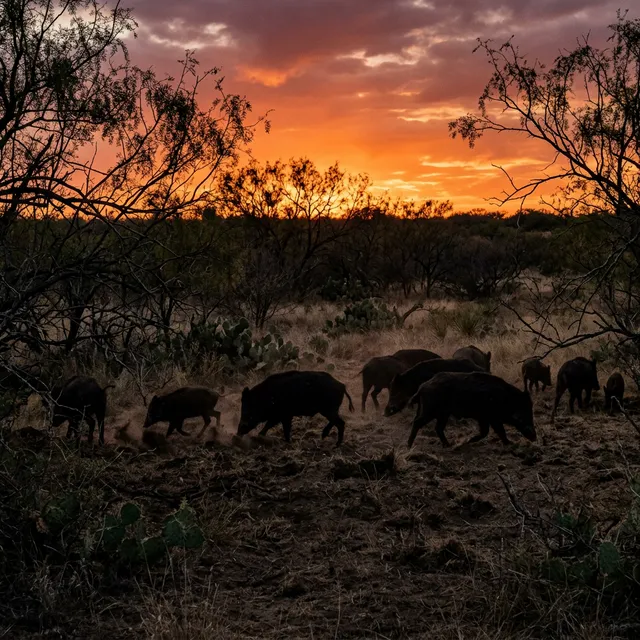
TL;DR — Key Takeaways
- No hunting license is required to hunt feral hogs on private land in Texas — effective since September 1, 2019 (SB 317).
- Feral hogs are classified as unprotected, non-native species: no closed season, no bag limit, and no possession limit.
- Night hunting, helicopter hunting, suppressors, and thermal/NV optics are all legal for hogs in Texas.
- A valid Texas hunting license IS required to hunt hogs on public land (WMAs, national forests).
- Texas has an estimated 2.5 million feral hogs causing $400+ million in annual agricultural damage.
In This Guide 8 sections
- Why Texas Has an "Open Season" on Feral Hogs
- License Requirements — When You Need One vs When You Don't
- Legal Hunting Methods — Night Hunting, Helicopters, Suppressors & Thermal
- Best Counties & Regions for Hog Hunting
- Public Land Hog Hunting
- Guided Hog Hunts — Helicopter, Night Vision & Budget Day Hunts
- Feral Hog Meat — Is It Safe? Processing, Cooking & Tips
- Non-Resident Hog Hunting in Texas
Why Texas Has an "Open Season" on Feral Hogs
Texas is ground zero for America's feral hog crisis. The state is home to an estimated 2.5 million feral hogs — the largest population of any state — causing more than $400 million in annual agricultural damage to crops, ranches, and native wildlife habitat. That's according to Texas A&M AgriLife Extension Service estimates.
Feral hogs are not native to the Americas. Descended from domestic pigs and Eurasian wild boar introduced by Spanish explorers in the 1500s, they've evolved into one of the most destructive invasive species in the United States. Their explosive reproduction rate (a sow can produce two litters per year of 4-6 piglets each) means control through hunting alone is insufficient, but it remains an important population management tool.
In response to this crisis, Texas adopted some of the most permissive hog hunting laws in the country:
- No closed season — Hogs can be hunted 365 days a year
- No bag limit — Take as many as you can
- No license required on private land (since 2019)
- Night hunting with artificial light is legal for hogs
- Helicopter hunting is legal with a permit
- Suppressors are legal for all hunting in Texas, including hogs
This combination of factors makes Texas the top destination in America for hog hunting, attracting both serious eradication efforts and recreational hunters looking for action-packed, affordable hunts.
License Requirements — When You Need One vs When You Don't
The passage of Senate Bill 317 (effective September 1, 2019) fundamentally changed hog hunting in Texas. Here's the breakdown:
No License Needed: Private Land
If you are hunting feral hogs on private land with the landowner's consent, no hunting license is required — for both Texas residents and non-residents. This was specifically designed to remove barriers to hog eradication on agricultural land.
However, even without a license requirement:
- Hunter education requirements still apply for anyone born on or after September 2, 1971
- All other game laws regarding legal methods of take remain in effect
- If you're carrying a firearm on someone else's property, you still need written or verbal landowner permission
License Required: Public Land
If you plan to hunt feral hogs on public land — including state Wildlife Management Areas (WMAs), national forests, or Army Corps of Engineers lands — a valid Texas hunting license is required.
| Scenario | License Needed? | Cost |
|---|---|---|
| Private land (with landowner consent) | No | Free |
| Public land (WMAs) | Yes — Annual Public Hunting (APH) Permit | $48 |
| National forests | Yes — Resident General Hunting License | $25 |
| Commercial hunting operations | No (private land) | Guided hunt fee only |
Trapping
If you plan to trap or snare feral hogs, TPWD recommends having a valid hunting license because trapping activities could inadvertently affect other wildlife species. Cage traps and corral traps are the most effective population reduction tools and are legal year-round with landowner permission.
Legal Hunting Methods — Night Hunting, Helicopters, Suppressors & Thermal
What makes Texas hog hunting truly unique is the extraordinary range of legal methods. Here's what's permitted:
Firearms — Almost Anything Goes
Any legal firearm can be used for hog hunting in Texas. Popular calibers include:
- .223/5.56mm — Affordable, high volume, good for smaller hogs under 150 lbs
- .308 Winchester / 7.62x51 — The workhorse caliber for Texas hog hunting; effective on hogs of all sizes
- .300 Blackout — Excellent for suppressed hunting, especially at night
- 12-gauge slugs or buckshot — Effective at close range in thick brush
Night Hunting
Night hunting for feral hogs is legal on private land year-round. When hunting at night:
- Artificial lights, spotlights, and feeder lights are all legal
- Thermal imaging and night vision optics are legal
- Recommended: Notify the local game warden before night hunting to avoid misunderstandings
- Night hunting on public land is generally prohibited unless specifically authorized
Suppressors (Silencers)
Suppressors are legal for all hunting in Texas, including feral hogs. Many night hunters prefer suppressed rifles to reduce noise disturbance on ranch properties and to protect hearing during extended hunting sessions.
Helicopter Hunting
Texas is the only state that widely offers helicopter hog hunting as a commercial recreational activity. Under TPWD regulations, aerial hunting of feral hogs is permitted with a landowner authorization and notification to TPWD.
Commercial helicopter hog hunts typically cost $1,500-$5,000 per flight (2-3 hours) and are based primarily in Central and South Texas. Hunters use semi-automatic rifles (typically AR-15 platform in .223 or .308) to engage hogs from a low-flying helicopter.
Archery & Crossbow
Bow hunting for hogs is legal year-round and is an increasingly popular method, especially over bait stations and around feeders. Many deer hunters take hogs opportunistically during archery deer season.
Hunting with Dogs
Using dogs to bay or catch feral hogs is legal in Texas and is a traditional method, particularly in East Texas and the Gulf Coast counties. Dogs locate and bay (corner) the hog, allowing the hunter to dispatch it with a knife or firearm, or capture it alive.
Best Counties & Regions for Hog Hunting
Feral hogs inhabit all 254 Texas counties, but certain regions have significantly higher populations and better hunting opportunities:
East Texas & Gulf Coast
The heaviest concentrations of feral hogs. Counties like Angelina, Nacogdoches, Liberty, Chambers, and Jefferson have dense hog populations in bottomland hardwoods, river bottoms, and agricultural land along the coast.
- Habitat: Thick pine/hardwood forests, creek bottoms, rice fields
- Best method: Baited stands, dogs, night hunting
- Public land: Sam Houston NF, Davy Crockett NF, Big Thicket National Preserve
Central Texas
The agricultural heartland of hog damage. Counties including Williamson, Milam, Lee, Burleson, and Bastrop have large hog populations driven by abundant corn, cotton, and hay crops.
- Habitat: Post oak savannahs, agricultural fields, river corridors
- Best method: Spot-and-stalk, baited feeders, thermal hunting at night
- Public land: Granger WMA, Somerville WMA
South Texas Brush Country
Dense brush and ranch land from Webb County east to Duval and Live Oak counties. South Texas ranches often offer combination deer/hog hunts since hogs are abundant everywhere.
- Habitat: Mesquite/prickly pear brush, senderos
- Best method: Blind hunting, helicopter operations
- Public land: Chaparral WMA, James Daughtrey WMA
Texas Panhandle & Rolling Plains
Growing hog populations in the agricultural areas of the Panhandle. While less dense than East Texas, the hog population is expanding rapidly in irrigated farmland.
- Habitat: Agricultural fields, river breaks, CRP grasslands
- Best method: Long-range rifle, baited stands
- Public land: Gene Howe WMA, Matador WMA
Public Land Hog Hunting
While hogs are everywhere in Texas, hunting them on public land requires a license and comes with specific regulations:
National Forests (Free with Hunting License)
All four Texas national forests in East Texas allow feral hog hunting:
- Sam Houston National Forest — 163,000 acres; excellent hog populations in bottomlands
- Davy Crockett National Forest — 161,000 acres; dense hog numbers near Neches River
- Angelina National Forest — 153,000 acres; good access via forest roads
- Sabine National Forest — 161,000 acres; less hunting pressure, good DIY opportunities
Hogs can be hunted during any open season on national forests with a valid Texas hunting license. No additional permit is required.
State Wildlife Management Areas (WMAs)
Many WMAs include feral hogs as a legal species during deer seasons and special hog hunts. An Annual Public Hunting (APH) permit ($48) is required. Check TPWD's regulations for specific WMA dates and methods.
Guided Hog Hunts — Helicopter, Night Vision & Budget Day Hunts
Texas has a thriving market for commercial hog hunting operations. Options range from budget-friendly ground hunts to premium helicopter experiences:
| Hunt Type | Typical Cost | What's Included |
|---|---|---|
| Budget day hunt (rifle, private land) | $150-$350/person | Guide, stand access, hog cleaning |
| Night vision/thermal hunt | $300-$800/person | NV/thermal optics, suppressed rifles, guide |
| Multi-day package (2-3 days) | $500-$1,500/person | Lodging, meals, multiple hunts, processing |
| Helicopter hunt (2-3 hour flight) | $1,500-$5,000/person | Helicopter, rifles, ammo, pilot/guide, photos/video |
| Trap & hunt combo | $200-$500/person | Corral trapping + ground hunting |
Tip: Many outfitters offer combination hunts where you can add hog hunting to a deer or exotic ranch hunt for little or no extra charge, since removing hogs benefits the ranch management.
Feral Hog Meat — Is It Safe? Processing, Cooking & Tips
Yes, feral hog meat is safe to eat when properly handled and cooked. In fact, wild hog — especially younger animals under 100 lbs — can be excellent table fare with a rich, pork-like flavor and significantly leaner than domestic pork.
Safety Considerations
- Cook to 165°F internal temperature minimum — feral hogs can carry trichinella, brucellosis, and other parasites
- Wear gloves when field dressing to avoid exposure to brucellosis bacteria
- Do not eat raw or undercooked wild pork under any circumstances
- Pseudorabies virus — while not dangerous to humans, it is fatal to domestic dogs, so keep hunting dogs from contacting raw hog blood
Best Eating
- Sows under 100 lbs — Tender, mild-flavored, best for chops and roasts
- Boars over 150 lbs — Stronger flavor; best for sausage, grinding, and slow-cooked barbecue
- Backstrap and tenderloin — Premium cuts comparable to domestic pork loin
Processing
Field-dress promptly and cool the carcass as quickly as possible — especially important in Texas heat. Many commercial processors accept feral hogs, though some require a separate processing area from domestic animals. Typical processing fees run $75-$125.
Non-Resident Hog Hunting in Texas
The Big Advantage
Texas is one of the best destinations for non-resident hog hunting because:
- No license needed on private land (since 2019) — this applies to non-residents too
- No season or bag limits — hunt hogs year-round
- Affordable — Budget guided hunts start around $150-350/person/day
- Guaranteed action — Most outfitters guarantee at least shooting opportunity
What to Bring
- Valid government-issued ID
- Hunter education certification (if born after Sep 2, 1971 — accepted from any state)
- Your own firearm, or arrange to use outfitter-provided equipment
- Cooler and ice for transporting meat
Best Timing
While hogs can be hunted year-round, many outfitters report the best action during:
- Summer (June-August) — Hogs congregate near water sources, excellent thermal/night hunting
- Winter (December-February) — Good daytime movement, can combine with deer season
- Spring (March-May) — Active rooting season, agricultural damage peaks, sows with piglets
- Hunting on Public Land — Access, Rules & Permits You Need to Know Complete guide to hunting on public land in the US. Learn about federal and stat…
- Non-Resident Hunting — Tips & Cost-Saving Strategies for Out-of-State Hunts Planning a hunt in another state? Learn how to save on non-resident hunting lice…
- Hunting License vs. Permit vs. Tag — What's the Difference? Confused by hunting licenses, permits, tags, and stamps? This guide explains eac…
Recommended Resources
Affiliate links — we may earn a commission at no extra cost to you. Learn more
Frequently Asked Questions
Do I need a hunting license to hunt hogs in Texas?
No license is required to hunt feral hogs on private land in Texas — this applies to both residents and non-residents. However, a valid hunting license is required for hog hunting on public land (WMAs, national forests).
Can I hunt hogs at night in Texas?
Yes. Night hunting for feral hogs is legal on private land in Texas year-round. Artificial lights, spotlights, thermal imaging, and night vision optics are all permitted. It is recommended to notify your local game warden before night hunting.
Is helicopter hog hunting legal in Texas?
Yes. Texas allows aerial hunting of feral hogs with landowner authorization and TPWD notification. Commercial helicopter hog hunts typically cost $1,500-$5,000 per 2-3 hour flight.
Is feral hog meat safe to eat?
Yes, wild hog meat is safe when properly cooked to an internal temperature of at least 165°F. Wear gloves during field dressing to avoid brucellosis exposure. Younger sows under 100 lbs tend to have the best flavor.
How many hogs can I kill in Texas?
There is no bag limit or possession limit for feral hogs in Texas. They are classified as an unprotected, non-native species, so you can take as many as you can year-round.
Do non-residents need a license to hunt hogs in Texas?
No. Since September 1, 2019, neither residents nor non-residents need a hunting license to hunt feral hogs on private land in Texas with landowner consent. A license is only required for public land hunting.
What is the best caliber for hog hunting in Texas?
.308 Winchester is the most popular all-around caliber for Texas hog hunting. For night hunting with suppressors, .300 Blackout is excellent. For high-volume shooting, .223/5.56mm works well on smaller hogs.
Where are the most feral hogs in Texas?
East Texas and the Gulf Coast region have the highest concentrations. Counties like Angelina, Nacogdoches, Liberty, and Chambers are hot spots. Central Texas agricultural areas also have very high populations.