
Texas Turkey Hunting 2026: Rio Grande & Eastern Seasons, Tags & Best Counties
Texas holds the nation's largest Rio Grande turkey population — here's how to hunt them across spring and fall seasons.
TL;DR — Key Takeaways
- Texas has two turkey subspecies: Rio Grande (abundant, statewide) and Eastern (limited, East Texas only with stricter rules).
- Spring Rio Grande season runs March 14 – April 26 (South Zone) and March 28 – May 10, 2026 (North Zone) — gobblers only.
- A valid hunting license plus an Upland Game Bird Endorsement is required for turkey hunting.
- Annual bag limit is 4 turkeys (1 per day) in most Rio Grande counties — Eastern turkey has a 1-turkey limit.
- All harvested turkeys must be reported within 24 hours via the Texas Hunt & Fish app or online.
In This Guide 8 sections
- Two Turkey Species in Texas — Rio Grande vs Eastern
- Spring & Fall Turkey Season Dates 2026-2027
- License Requirements — What Tags You Need
- Best Counties for Turkey in Texas
- Public Land Turkey Hunting Spots
- Gear & Calling Strategies for Texas Conditions
- Youth Turkey Season — Dates & Special Rules
- Non-Resident Turkey Hunting Costs
Two Turkey Species in Texas — Rio Grande vs Eastern
Texas is one of the few states blessed with two distinct wild turkey subspecies, each offering a different hunting experience:
Rio Grande Turkey
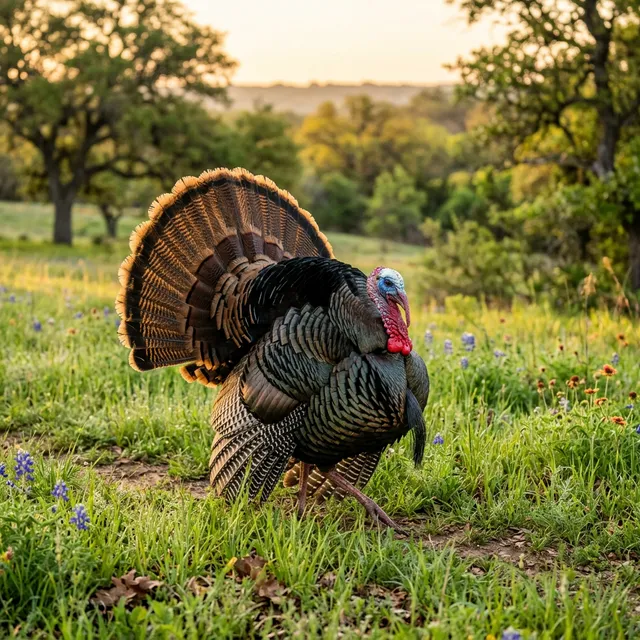
The Rio Grande turkey (Meleagris gallopavo intermedia) is the dominant subspecies, found across the vast majority of Texas from the Edwards Plateau to the Rolling Plains, Hill Country, South Texas, and the Panhandle. Texas holds the largest Rio Grande turkey population in the United States, estimated at over 500,000 birds.
Rio Grande turkeys are highly adaptable, thriving in semi-arid brush country, oak savannahs, river corridors, and agricultural lands. They tend to roost along creek and river bottoms lined with cottonwood, pecan, and liveoak trees, then fan out across open country during the day.
Key characteristics:
- Slightly lighter coloring than Eastern turkeys, with buff-tipped tail feathers
- Longer legs adapted for covering ground in open terrain
- More likely to be found in large flocks (50-200+ birds not uncommon in winter)
- Vocal and responsive to calling, especially during spring breeding season
Eastern Turkey
The Eastern turkey (Meleagris gallopavo silvestris) inhabits the piney woods and hardwood forests of East Texas — roughly the area east of I-35. Eastern turkeys have darker plumage, are generally warier, and exist in smaller populations than their Rio Grande cousins.
Due to their limited numbers and ongoing restoration efforts, Eastern turkeys are subject to significantly stricter regulations:
- Separate season with later dates
- Lower bag limits (1 turkey per spring season in the East Zone)
- Some areas may require special draw permits
- Fall hunting for Eastern turkeys is more restricted
Spring & Fall Turkey Season Dates 2026-2027
Turkey hunting in Texas is divided by zone, species, and season. Here are the official TPWD dates:
Spring Season 2026 (Rio Grande Turkey)
| Zone | Dates | Bag Limit |
|---|---|---|
| South Zone | March 14 – April 26, 2026 | 4 gobblers/season, 1/day |
| North Zone | March 28 – May 10, 2026 | 4 gobblers/season, 1/day |
| Youth-Only (South Zone) | March 7-8 & May 2-3, 2026 | Same as general |
| Youth-Only (North Zone) | March 21-22 & May 16-17, 2026 | Same as general |
Spring Season 2026 (Eastern Turkey)
| Zone | Dates | Bag Limit |
|---|---|---|
| East Zone | April 22 – May 14, 2026 | 1 gobbler/season |
Fall Season 2026-2027 (Rio Grande Turkey)
| Zone | Dates | Notes |
|---|---|---|
| Archery Only | Oct 3 – Nov 6, 2026 | Statewide, either sex |
| North Zone | Nov 7, 2026 – Jan 3, 2027 | Either sex in most counties |
| South Zone | Nov 7, 2026 – Jan 17, 2027 | Either sex in most counties |
| Brooks/Kenedy/Kleberg/Willacy | Nov 7, 2026 – Feb 28, 2027 | Extended season |
Spring hunting is gobblers only — you must positively identify a beard before pulling the trigger. Fall seasons allow either-sex harvest in most counties, making fall an excellent opportunity for filling the freezer with turkey.
Important 2026-2027 Changes
- Hill County: IH35E now serves as the zone boundary line for wild turkey
- Lubbock County: Newly opened to wild turkey hunting under North Zone regulations
- Mandatory harvest reporting: All harvested wild turkeys must be reported within 24 hours through the Texas Hunt & Fish mobile app or online portal — this is a statewide requirement
License Requirements — What Tags You Need
Turkey hunting in Texas requires the following:
| Item | Cost (Resident) | Cost (Non-Resident) | Notes |
|---|---|---|---|
| General Hunting License | $25 | $315 | Base requirement |
| Upland Game Bird Endorsement | $7 | $7 | Required for turkey |
| Super Combo | $68 | N/A (residents only) | Includes all endorsements |
What's Included
Your turkey tags are integrated into your hunting license — TPWD does not issue separate physical turkey tags. The annual bag limit (4 Rio Grande / 1 Eastern in spring) is tracked through the mandatory harvest reporting system.
The Best Value
For residents, the Super Combo ($68) is the best option because it includes the Upland Game Bird Endorsement along with all other endorsements. If you already have a general hunting license, you can add the Upland Game Bird Endorsement for $7.
Non-Resident Options
Non-residents need the $315 General Hunting License plus the $7 Upland Game Bird Endorsement, totaling $322 for turkey hunting. There is also a Non-Resident Spring Turkey License ($132) that only authorizes spring turkey hunting — no deer, no other big game.
Best Counties for Turkey in Texas
Edwards Plateau (Hill Country)
The epicenter of Rio Grande turkey hunting in Texas. Kerr, Llano, Mason, Gillespie, Kimble, and Real counties consistently produce excellent spring gobbler hunts. The mix of liveoak mottes, creek bottoms, and open meadows creates ideal turkey habitat.
- Why it's great: Highest density of Rio Grande turkeys in the state
- Terrain: Rolling hills, liveoak/juniper woodlands, creek bottoms
- Tips: Focus on roosting sites along creek corridors; turkeys here respond well to aggressive yelping and cutting
- Access: Mix of private ranches and WMAs (Kerr WMA is outstanding for turkey)
Rolling Plains
The counties of Haskell, Shackelford, Throckmorton, Young, and Stonewall in West-Central Texas offer excellent turkey hunting with less competition than the Hill Country. River corridors through open ranchland concentrate birds.
- Why it's great: Lower hunting pressure, large flocks, responsive birds
- Terrain: Open grasslands with timbered river breaks
- Tips: Glass open meadows at dawn for strutting gobblers, then set up along travel corridors
- Access: Primarily private land; contact local landowners for access
South Texas
Rio Grande turkeys thrive in the brush country of Webb, Duval, McMullen, Live Oak, and La Salle counties. Many deer hunting ranches also offer turkey hunts in spring.
- Why it's great: Early season (March 14 opener); combines well with spring deer scouting
- Terrain: Dense mesquite/prickly pear brush with senderos
- Tips: Water sources are key in arid South Texas — set up near stock tanks and windmills
- Access: Almost entirely private ranches; guided hunts available
East Texas (Eastern Turkey)
For hunters seeking the challenge of Eastern turkeys, the counties east of I-35 including Angelina, Nacogdoches, Cherokee, and Jasper hold huntable populations. Eastern turkey hunting requires more patience and woodsmanship.
- Why it's great: True Eastern turkey experience in classic hardwood forests
- Terrain: Pine/hardwood forests, creek bottoms, food plots
- Tips: More subtle calling is essential — Easterns are notoriously wary
- Access: National forests offer free access; Bannister WMA and Moore Plantation WMA
Public Land Turkey Hunting Spots
Turkey hunting on Texas public land is competitive but productive:
Wildlife Management Areas (WMAs)
The following WMAs are top picks for spring turkey:
- Kerr WMA (Hill Country) — Arguably the best public land turkey hunting in Texas. High-density Rio Grande population in classic Hill Country habitat. Requires APH permit ($48).
- Mason Mountain WMA (Hill Country) — Smaller acreage but excellent turkey density. Draw-only hunts may apply.
- Gene Howe WMA (Panhandle) — Underrated option for Rio Grande turkeys along the Canadian River breaks.
- Chaparral WMA (South Texas) — Good spring gobbler opportunity in South Texas brush.
National Forests
All four East Texas national forests offer free turkey hunting with a valid hunting license and Upland Game Bird Endorsement. Eastern turkey hunting in the national forests is the best DIY option for budget hunters:
- Sam Houston National Forest — Best public land Eastern turkey populations
- Davy Crockett National Forest — Good concentrations near food plots and wildlife openings
- Angelina & Sabine National Forests — Lower pressure, more remote hunting
Gear & Calling Strategies for Texas Conditions
Essential Gear
Turkey hunting in Texas differs from northern states due to the warm climate and open terrain:
- Lightweight camo — Temperatures during spring season regularly hit 75-85°F; choose breathable fabrics
- Shade-providing setup — A pop-up ground blind provides shade, concealment, and a comfortable wait
- Snake protection — Rattlesnakes are active during spring turkey season; snake boots or gaiters are essential in most of Texas
- Water — Carry at least 2 liters; dehydration is a real risk during late-morning hunts
- Decoys — Rio Grande turkeys respond well to decoy setups, particularly a jake-and-hen combo during peak breeding
Calling Techniques for Rio Grande Turkeys
Rio Grande turkeys are generally more vocal and responsive than Eastern turkeys, which means aggressive calling can be very effective:
- Yelping — Standard hen yelps are the foundation; Rio Grandes respond to loud, excited yelping
- Cutting — Sharp, excited clucks work well to trigger a shock gobble or pull a hung-up gobbler
- Kee-kee — Effective during fall season for locating scattered flocks
- Gobble call — Can be effective (and dangerous during spring season — use carefully) to challenge dominant toms
- Locator calls — Crow, owl, and coyote howl calls work well for roosted birds at dawn
Calling Strategies for Eastern Turkeys
Eastern turkeys in East Texas require a more subtle approach:
- Start with soft tree yelps before flydown
- Less is more — long pauses between calling sequences
- Be prepared for birds to approach silently
- Patient setups near travel routes and strut zones are more productive than running-and-gunning
Youth Turkey Season — Dates & Special Rules
Texas offers dedicated youth-only turkey seasons to introduce young hunters to the sport:
Spring Youth Seasons 2026
| Zone | Early Dates | Late Dates |
|---|---|---|
| South Zone | March 7-8, 2026 | May 2-3, 2026 |
| North Zone | March 21-22, 2026 | May 16-17, 2026 |
Youth Requirements
- Youth hunters must be under 17 years of age
- Must be accompanied by a licensed adult mentor (21 or older)
- Youth need a valid hunting license or youth combo ($7 resident)
- All other regulations apply, including the Upland Game Bird Endorsement and mandatory harvest reporting
Youth seasons provide an excellent opportunity to hunt before the general season opens, when birds tend to be less pressured and more responsive to calling.
Non-Resident Turkey Hunting Costs
License Cost Breakdown
| Item | Cost |
|---|---|
| Non-Resident General Hunting License | $315 |
| Upland Game Bird Endorsement | $7 |
| OR Non-Resident Spring Turkey License | $132 |
| Guided spring turkey hunt (3-day) | $1,500-$3,500 |
| DIY public land hunt | $200-$500 (gas, food, lodging) |
Why Non-Residents Choose Texas Turkey Hunting
- Longest spring season in the country (up to 8+ weeks depending on zone)
- No draw or tag lottery — buy your license and hunt
- High turkey density means consistent action
- Warm weather hunting compared to northern states still dealing with spring snowstorms
- Combination opportunity — add hog hunting (free on private land) to your turkey trip
Texas's spring turkey season is an excellent "shoulder season" hunt for non-residents who want to escape late winter in northern states and enjoy guaranteed warm-weather gobbler action.
- Texas Deer Hunting: Complete 2026 Guide to Seasons, Tags & Regulations Plan your Texas deer hunt with our 2026 guide covering seasons, license costs, a…
- Texas Feral Hog Hunting: No License Needed on Private Land — Rules, Methods & Where to Go Hunt feral hogs in Texas without a license on private land. Learn legal methods …
- Hunting on Public Land — Access, Rules & Permits You Need to Know Complete guide to hunting on public land in the US. Learn about federal and stat…
Recommended Resources
Affiliate links — we may earn a commission at no extra cost to you. Learn more
Frequently Asked Questions
What is the turkey bag limit in Texas?
For Rio Grande turkeys, the annual bag limit is 4 turkeys (1 per day) in most counties during spring season — gobblers only. Eastern turkeys have a stricter 1-turkey limit during spring season. Fall seasons may allow either-sex harvest.
Do I need a special endorsement for turkey hunting in Texas?
Yes. In addition to a valid hunting license, you need an Upland Game Bird Endorsement ($7). The Super Combo ($68 resident) includes this endorsement along with all others.
When does spring turkey season start in Texas?
The 2026 South Zone Rio Grande season opens March 14, and the North Zone opens March 28. The Eastern Turkey East Zone season opens later on April 22. Youth-only seasons open 1-2 weeks before general season.
Do I need to report my turkey harvest in Texas?
Yes. All harvested wild turkeys must be reported within 24 hours through the Texas Hunt & Fish mobile app or online portal. This is mandatory for all turkey harvests statewide.
Can I use a crossbow during turkey season in Texas?
Yes. During archery-only turkey season (Sep 27 – Oct 31), crossbows are legal alongside compound bows and recurves. During general firearm season, any legal weapon including shotguns with #4 shot or smaller is permitted.
What is the difference between Rio Grande and Eastern turkeys?
Rio Grande turkeys are more abundant, found across most of Texas, and tend to be more vocal and responsive. Eastern turkeys live only in East Texas, have darker plumage, and are warier. Eastern turkey seasons have stricter bag limits.
Where is the best public land for turkey hunting in Texas?
Kerr WMA in the Hill Country is widely considered the best public land turkey spot for Rio Grande turkeys. For Eastern turkeys, Sam Houston National Forest offers the best free public access.
How much does a non-resident turkey license cost in Texas?
Non-residents can get a dedicated Spring Turkey License for $132, or a General Hunting License for $315 (which also covers deer and other game). Both require an additional $7 Upland Game Bird Endorsement.